

Episode 3
Angelo San Giorgio: Family, Business & Letting Go
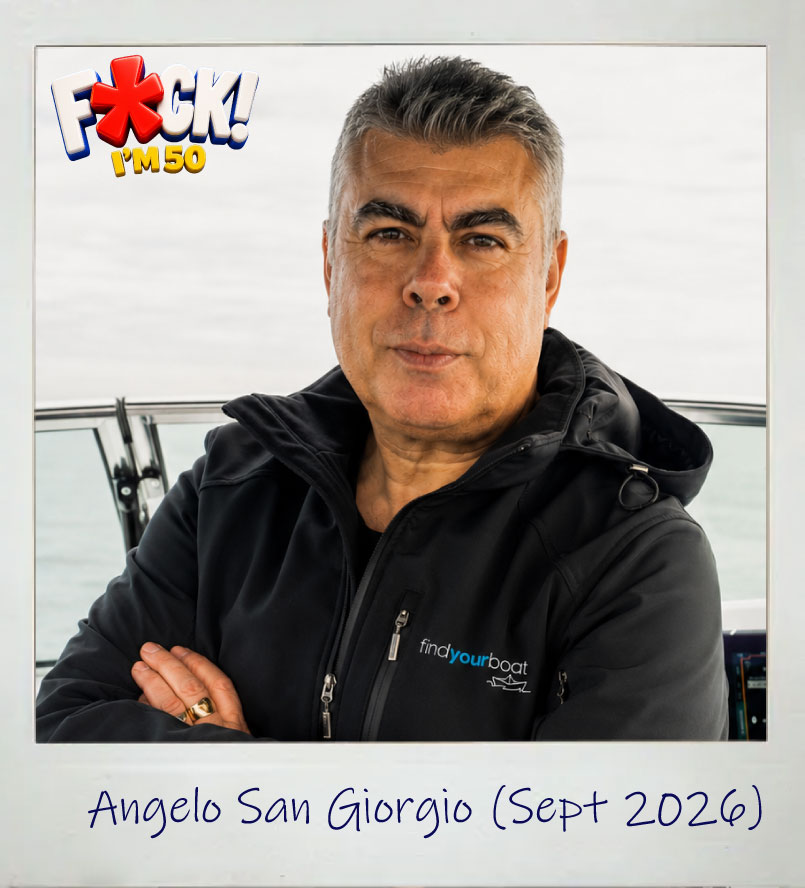
I caught up with Ange at a café in Melbourne for a chat about family, business, following your passions and what happens as the generations around you start to change.


Listen to the episode
About this episode
Angelo San Giorgio is a dad, husband, grandfather, boating and camping tragic, and a bloke who still somehow manages to dress like he’s 25.
I caught up with Ange at a café in Melbourne for a chat about family, business, following your passions and what happens as the generations around you start to change.
With a background in sales and marketing, Ange talks about turning something he loves into a business, the influence family has had on his life, and learning that sometimes giving people the space to go their own way can actually bring everyone closer when it matters.
We talk about being a son, becoming a dad and then a grandfather, the changing dynamics between generations, and some of the lessons that only really make sense once you’ve lived through them yourself.
Ange is a funny bloke with a great story spanning two countries, plenty of family history and a few different chapters along the way.
Grab a coffee and enjoy the chat.
This is F*CK! I’M 50.
About Angelo San Giorgio
Angelo San Giorgio is a dad, husband, grandfather, boating and camping tragic, and a bloke who still somehow manages to dress like he’s 25.
With a background in sales and marketing, Ange talks about turning something he loves into a business. His story spans two countries, plenty of family history and a few different chapters along the way.
Transcript
Read the Episode 3 transcript
Transcript lightly edited for clarity.
Paul:
On a recent trip to Melbourne, I caught up with an old mate of mine, Angelo San Giorgio.
We met through business dealings years ago, and Angelo has a pretty interesting background. We’re in the same age group, he has an interesting family story and he’s had quite a career.
We thought it might be good to have a chat.
Here we go: Angelo San Giorgio, the first of the F*CK! I’M 50 interview series.
You and I have known each other for probably 15 years, I reckon. I’ve been in Airlie Beach for 12 years—10 years, sorry—and we did plenty of projects before that.
Angelo:
It was 2012.
Paul:
So that’s 14 years. Almost 15. There you go—and we both don’t look a day older.
Angelo:
My wife might say differently.
Paul:
Everyone listening, this is F*CK! I’M 50, and this is my mate Angelo.
Your kids cover quite a big age range.
Angelo:
They do. They span 17 years.
My eldest daughter is getting married later this year, in November. She’s 27 and about to turn 28. My youngest is 10, about to turn 21—apparently.
Between them, I have a 25-year-old daughter and a 17-year-old son.
We had our first pregnancy when I was 29. We’d had a couple before then that didn’t work out, but our first baby was born when I was 29.
We were 47 when we had the last one.
It was described as a geriatric pregnancy, and we were told to terminate several times. We thought we’d forgotten how it happened. The kids thought it was gross.
When I look at my eldest and youngest daughters together, it’s like looking at the same person at two different stages of life.
I get to relive everything we did with the older children through the youngest—but there’s much more screen interaction and social media influence now.
Back then, I was the influence. Mum was the influence, along with a few school friends. Now we’re the background noise.
Paul:
Do you see a big difference between the 27-year-old—or even the 25-year-old—and the 10-year-old when it comes to instant gratification?
My kids are 16, 19 and 24. Everything is instant for them. They don’t know a life with dial-up internet.
That isn’t necessarily bad. The world is pretty cool when you look at what we can do these days—but they don’t know anything different.
Angelo:
My eldest daughter has taken it and turned it into a career.
It’s partly based on what we were doing together in the Trade-A-Boat days. She was involved in that, coming along on shoots and jumping wakes in boats.
She went into the superyacht industry, then came out of it during COVID. She moved to Wollongong with a bloke she met on a superyacht in Airlie Beach.
Paul:
That sounds like an episode of Below Deck.
Angelo:
It is! They were asked to participate in Below Deck, but they knew it could be career suicide—and potentially long-term suicide.
She loved media and marketing, so she stuck with it. She came home with a lot of cash because when you’re working on superyachts, everything is covered for you.
They now own three homes. She lives an idyllic life in Wollongong with a bloke she loves, and Dad’s a happy camper.
We obviously don’t see each other every day, but I think that distance is important for us. When we do connect, it gives us something to hold onto.
There’s a generation gap between us, but when we’re together, we have so much to talk about. We can reminisce about everything we did together.
There’s plenty of common ground because we went camping and boating, spent time at boat shows and worked on shoots together.
They still talk about the shoot we did at Lakes Entrance—and being stuck up that creek early in the morning with you in the little helicopter.
Paul:
That helicopter was a bit scary. It looked like a relic from MASH*.
It was supposed to be a Robinson R44. When it came over the hill, I remember thinking, “Jesus Christ, this is going to be exciting.”
I think it was a Schweizer 300.
These days, we don’t even need to use real helicopters for that work. It’s amazing.
Tell me a little about yourself. What do you do, and what’s your business? Give yourself a gratuitous plug for our millions of listeners.
Angelo:
I’m about to launch a new business called Find Your Boat.
It evolved from another business called Boat Experts, which was this grandiose combination of AI, human interaction, creating funnels for dealers and working with buyers. It was simply too big.
Paul:
You’ve got to keep it simple, stupid. Isn’t that the old adage?
Angelo:
That’s right.
When I tried explaining the original business to people, their eyes would glaze over after the first 10 seconds.
When I spoke to potential buyers, who were my main audience, all they wanted to know was: “Can you help me buy a boat, and can you work for me instead of the dealers?”
That’s what the new model does.
We handle all the negotiation. If you don’t know what you want, we’ll help you work it out. We’ll deal with any dealer, anywhere in Australia, and arrange to have the boat delivered to your door for a one-off flat fee.
I was initially worried about that fee because it’s difficult to ask people for money upfront when they don’t know exactly what they’re getting.
We trialled it with a few people, and most of them ultimately wanted to give me more because the service they received was worth more than I had been able to quantify.
I like lists and spreadsheets. I’d think, “I’m going to do these things for you, it will take this much work, so I’ll charge you this amount.”
But the value went beyond that. They didn’t have to deal with the dealers. They could get exactly what they wanted. I handled the negotiation and arranged the handover.
Before all that, I made sure what they were getting was actually what they wanted. I checked that what appeared on the contract was on the finished boat, and that the entire deal fitted their budget and their needs—rather than the dealer simply selling them whatever was in stock.
That became the catchphrase: giving you the boat you deserve, rather than the one they want to sell you.
Paul:
A good part of that model is that you aren’t holding stock or committed to a particular brand. You can work anywhere in Australia—and then, obviously, you can take people out and teach them how to use the boat.
Angelo:
Correct. That’s an additional service, but it isn’t the core of the business.
Ultimately, Find Your Boat exists to give me time. I don’t want to work a nine-to-five job again.
Paul:
I hope I wasn’t a bad influence.
Angelo:
You were—but you were a great employer.
I do lots of different things. I design boats, create white-label content for companies and help businesses solve problems.
I sometimes think of myself like the little Dutch boy: if a company has a hole in its dyke, I’ll stick my finger in it.
I’ve found a niche working with generational companies, particularly in the boatbuilding and recreational vehicle industries.
They’ve often been doing things on autopilot for the last 20 years, and many have found that their competitive edge has dropped. They think the answer is social media or the internet, but those are often just words to them. They don’t know how to engage with any of it.
That’s where I come in.
I start by looking at the business. Often, what they’re failing to do externally reflects something they’re also failing to do internally. They’re too close to it.
Paul:
One reason I gave you a call and said, “Mate, I’m finally doing this podcast I’ve spoken about for years,” is that you’re one of those personalities who has been kicked in the guts a few times through employment, big businesses being sold and other things.
Angelo:
Some of them were mistakes I walked into with my eyes open. Some were self-induced.
Paul:
I’ve been there too.
What I love is that you bounce back off the ropes and reinvent yourself. Even now, you’ve moved from Boat Experts to Find Your Boat.
You can head in one direction, recognise that it isn’t working and make a change. You said yourself that people’s eyes glazed over within 10 seconds when you explained the previous idea.
What you’ve described now is much cleaner: “Help me buy a boat.”
That ability comes with life experience.
The premise of this show is to talk about what comes next in our lives.
You’re a little older than me. I call myself a three-star gold member of the 50 Club because I’m 53. By my maths, you’re a seven-star gold member.
Angelo:
I’m 57, so I’m closer to 60 now than 50.
Paul:
Why do you dress like a 25-year-old?
Angelo:
Because that’s how I feel.
When I look in the mirror, the person I see may or may not be what other people see. I don’t give a shit anymore. I wear what I feel comfortable in.
At the moment, it’s also because I can still fit into these clothes.
The last time we met, I was almost 100 kilograms. I’m hovering around 83 or 84 now, and my goal is to reach 75 for my daughter’s wedding.
This top I’m wearing is something I bought 20 years ago.
Paul:
I think I weighed 75 when I was 18.
Angelo:
I work on little goals. That’s something I learned from you as well: if someone gives you an opportunity, say yes and then figure it out.
At the same time, learn from the people around you.
I’ve always been a sponge, and I don’t mean that negatively. I absorb everything, then distil and filter what I need for where I am at that stage of life.
I’ll use that information and keep the rest in reserve until I need it.
Like you, I lost a parent recently.
Paul:
My old man is still kicking, but he’s as good as gone. Dementia is a horrible thing.
You’re dealing with someone who is physically there but isn’t really there anymore.
I can imagine that losing a parent when they are physically gone is incredibly difficult.
Angelo:
Mum suffered from a neurological disorder.
Initially, her muscles began to give out. Eventually, she became trapped in her own body. She couldn’t walk or feed herself anymore.
In the end, it was left to Dad and us—but mainly Dad—to care for her.
Mum and Dad were only four months apart in age. Mum was slightly older.
They celebrated their 60th wedding anniversary while she was in a nursing home. It was after COVID, although that period is a bit of a blur.
Two days after their anniversary, I was sitting with her, still wearing one of those stupid blue masks and holding her hand.
I received a call from a client. I let go of her hand for a minute to answer it and responded to another message.
When I took her hand again, it was cold.
It happened that quickly. She was gone within those few minutes.
Paul:
My brain immediately goes to the fact that she wasn’t alone.
I don’t mean to belittle the situation, but you were there. You were distracted for a moment, but you were there with her.
Angelo:
I had taken my mask off beforehand so she could see who I was.
When I looked into her eyes, I could still see my mum somewhere in the background. The person in front of me was a remnant of her.
Paul:
I call them hollow hugs or empty hugs.
Dad puts his arms around me when I visit him. I flew down yesterday and went to see him straight away. That hug was empty.
But four or five months ago, I got a proper hug. That was really cool.
Mum is struggling with the whole thing. I’ve been trying to help her reframe it.
I love reframing how I think about things. I’m certainly no guru, I don’t profess to be one and nobody should listen to me in that regard.
But I’m working on the theory that we’re lucky to still have Dad.
He could have had a stroke and died. That would have been the end of the story. In reality, it might have been a much nicer way for him to go, because this is shit.
But in a strange way, we’re lucky that we still get to visit him.
It isn’t really him, and he would hate the situation he’s in. Under the current laws, there’s nothing we’re allowed to do about that.
At least we can still see him. We can smell him and touch him.
Occasionally, something comes out of the blue. He’ll have a giggle or say something.
Yesterday, I introduced myself to someone at the nursing home. Dad said, “Oh yeah, it’s Paul,” because he repeated what he’d just heard.
To me, that was huge—even if he was only repeating something.
Angelo:
Those are moments you can cherish: the little flashes of lucidity within that almost blank stare.
Mum passed away over a period of years. That was effectively what was happening, although nobody described it in those terms.
What you’re experiencing now is very similar.
I think it gives you time to reflect. It made me appreciate sacrifices Mum had made that I hadn’t understood before.
Paul:
It’s funny how you don’t appreciate even the little things, like your mum making a sandwich for you to take to school.
At the time, you’d say, “Mum, I don’t want that. I want to buy something today.”
Even staying with my mum while I’m in Melbourne for a few days can be funny. Part of you thinks, “Can you let me do my own thing? I’m a 53-year-old man.”
Then she comes over, holds your hand, kisses you on the cheek and says thank you. You realise how much those moments mean.
That’s one of the strange and wonderful things I thought about when I finalised the show.
As you know, I don’t mind swearing. I’m not a crass kind of bloke and I don’t use the C-bomb or anything like that.
But I wanted a title that represented where we are: F*CK! I’M 50.
You arrive at this age and think, “Fuck, I’m 50. Where did the last 20 years go?”
My kids hardly need me anymore. Of course they still need me, but that’s the general feeling. Meanwhile, my parents need me more than ever.
My wife told me it’s called the sandwich generation. We’re stuck in between.
I’ve never had a normal job, and I don’t profess to want one. I don’t necessarily give career advice, either.
But if I see something I want to try, I’ll have a go. If I fail, so be it. I’ll step forward and move on to the next thing.
What differences do you find between the situations your children are navigating?
You have a daughter getting married, a 10-year-old still at school who thinks she’s 21, and a 17-year-old son navigating a relationship with his girlfriend in New Zealand.
Angelo:
The old long-distance relationship adds another level of complexity to our family dynamic.
She’s a great girl. We had our moments because we were trying to cushion him from what could happen in a long-distance relationship.
But they’re making it work. He has plans.
When we finally sat down and spoke to them as adults, instead of telling them what we thought they should do as kids, we listened. They had concrete plans in place.
They have support from her parents over there and from us here, wherever they decide to be.
If it were me, I’d be doing the same thing. I wouldn’t choose my parents over the person I loved. I didn’t before, and I wouldn’t now.
Paul:
That’s another big difference I’ve noticed with the younger generation. Their lives are international and digital.
My oldest is 24. She has movie nights with friends in America. They share a screen, make popcorn and watch together, even though they’ve never met in person.
That’s simply their life.
I can’t completely relate to it, but they have friends around the world with similar interests, whether that’s gaming or something else.
My other daughter has friends whose partners live in different parts of Australia. They make it work.
They won’t let the relationship get in the way of study or their career. The relationship is accepted for what it is, and they see each other when they can.
I’ve also been reading that younger people are moving away from drinking.
Angelo:
Yes, although anecdotally there seems to be a resurgence of the modern version of smoking, which is vaping.
I don’t understand how that became cool.
Perhaps we were the same when we were young. You can see and understand the health implications and long-term negative effects of something, but you do it anyway.
People told my dad, “You’ve got to stop smoking. You’ll be dead by the time you’re 50.”
Well, he’s in his eighties now.
He has made some wacky decisions, but he’s still getting around. He hasn’t smoked for a long time.
Thankfully, my kids don’t smoke or take drugs.
Paul:
I’ve never been a smoker. I can’t stand cigarette smoke.
Back in the day, though, you’d go into clubs and the room would be a haze. The amount of second-hand smoke I inhaled must have been out of control.
I never actually put a cigarette in my mouth—or inhaled, as Obama might say.
Jesus, “put it in my mouth” could be taken out of context.
Angelo:
Getting back to the generational difference, younger people have many more resources available to them and access to far more information.
But there’s so much information that it can be difficult to filter.
There was less information for us to absorb. We weren’t constantly bombarded when we were younger, and I think it was easier to decide what was right or wrong for us.
It’s harder for them because so many relationships and influences are online and overseas. They’ll believe something they see on TikTok.
Paul:
They see something and accept it as fact when it may not be true.
I don’t believe anything I read in the media these days. I’ll go to three or four different sources.
Then there’s my darling old mum. She answers every phone call she receives.
I tell her, “You don’t have to answer every call.”
She says, “It could be someone important.”
It might be—but it also might not be.
If I don’t recognise a number, I won’t answer. My phone is permanently on silent or Do Not Disturb. My daughters, son, wife, brother and mum can still get through. Anyone else can leave a message.
My voicemail now says, “If it’s important, leave a message and I’ll call you back. If I don’t call you back, it probably wasn’t important to me—or I missed the message. Send me an email. I have other things going on.”
Angelo:
We’re in our fifties. We only have so much time left to do the things we want to do.
If something isn’t important, I’m not going to focus on it.
I’ll try anything I feel I need to try, but if I don’t like it, I’ll stop just as quickly as I started.
I only have a limited amount of time left to experience, learn and grow from those things.
If something doesn’t involve my family, my kids or my grandkids—I didn’t want to mention the grandkids yet—but if one of them calls, that comes first.
Everything else is noise.
Paul:
I’ve always worked on a philosophy I read years ago in a book by Dr Wayne Dyer. I think the book was called Believe and Achieve.
He said to have your goal set in concrete and your path set in sand.
I’ve always known roughly where I wanted to end up, which is pretty much where I am now.
Money has come and gone. Businesses have come and gone. Thankfully, the good relationships have continued. All the important ones have certainly continued.
The people whose relationships with me haven’t continued know who they are—and it doesn’t really matter.
I’ve always believed in restarting, regenerating and moving forward. It’s like a game of snakes and ladders.
Angelo:
I still know where I’m going, but we roll the dice.
Sometimes we move up a ladder. Sometimes a snake gets us and we move down. But we’ll always get to where we want to be.
Where we want to be is different for everyone.
For me, at this stage of life, it has changed a lot.
I don’t need lots of money, although I once thought I did. I just need enough.
I don’t need the flashiest car.
I need time.
Paul:
That’s the one thing I know I’m running out of.
When your parents told you these things growing up, you thought, “Bullshit.”
Angelo:
I echo my parents every day, even though I always said I wouldn’t.
I think I can listen to my children more than my parents listened to me. I don’t whack my kids—not that being whacked affected me that much.
But even with my children, I have a limited attention span.
Paul:
These days they call that ADHD, mate.
Angelo:
I don’t know. I think that’s what I would have been diagnosed with when I was younger.
Paul:
They said that to me about two years ago.
We did some testing, and they said, “Paul, you’re definitely on all the spectrums for ADHD.”
I went home and told my family that the doctors had done the testing and put me on medication.
My kids said, “Yeah, no shit.”
Angelo:
It seems as though every second person is diagnosed with something.
Looking back at school, I could probably say I had everything.
I might have been gay because I once looked at a boy and thought he was good-looking. I might have been trans because I once dressed in my mum’s clothes.
I might have been everything—and yet I’m all of those things and none of them.
At the moment, it seems that as soon as someone exhibits a particular trait, the world tries to put them into a silo.
“That’s what you are.”
You’re pigeonholed.
Paul:
I struggle with that in life.
People ask, “What do you do for a living? How do you actually make a living? What do you do for work?”
My company is called 64 Brands because Dad always said I had 64 things going on at once.
That describes me, because my brain keeps going. As you said before, we’ll be talking at two in the morning.
That’s how my brain works. I have to work within the spectrum I’ve been given.
Angelo:
Sometimes you can’t determine when creativity will strike.
I’ll wake up in the middle of a dream with something I think is valuable. I’ll get up and write it down.
When I look at it in the morning, it either makes sense or it doesn’t.
Paul:
A psychologist taught me to keep a notepad and pencil next to the bed. It has to be a pencil.
When you wake up, don’t turn on a light. Reach over, grab the pad, write down whatever is in your mind and don’t look at it until morning.
If you can decipher what you wrote, perhaps it was important enough to keep you awake. If you can’t work out what the hell you wrote, you have to learn to let those ideas go.
It helped me differentiate between the important things keeping me awake and the random, stupid ideas.
I’ve just realised I’m tapping my cardboard coffee cup right next to the microphone.
You mentioned earlier that when your mum passed away, your dad went off the rails a little.
Can you expand on that without getting too personal?
Angelo:
They had always dreamed of spending their twilight years travelling.
They’d completed one or two laps of Australia. The last trip was interrupted at the beginning of COVID. Mum was starting to become ill, and they were afraid to enter populated areas.
They put everything on hold when Mum became far less mobile.
My last memory of her being truly vibrant and happy was when she was out of her wheelchair and sitting on a bar stool aboard a trimaran in Airlie Beach.
She was spinning around on the stool at the yacht’s bar while my daughter served her. That picture takes pride of place in both our homes.
From there, she went downhill.
Even before Mum passed away, Dad started doing odd things.
He was scammed several times. We helped fund his lifestyle for four or five years because he kept losing money.
A scam would promise him a way to make money. When I looked at it, I’d think, “This is obviously a scam.”
Someone would say they would give him money but needed authority to access his account. They might give him $5,000, then make him promise to send it back before supposedly giving him another $2,000.
Paul:
My parents experienced something similar when they were selling their caravan because Dad was reaching the point where he couldn’t drive anymore.
The day they listed it, Mum rang me excitedly because someone wanted to buy it.
The buyer claimed to be in Darwin while Mum and Dad were in Melbourne. They said they owned a freight company and would pay the full purchase price, but Mum and Dad had to pay the freight component first.
They claimed they would deposit it into Mum’s PayPal account.
Mum was about to send them something like $16,000 to cover the freight.
I said, “No, no, no, no, no!”
Angelo:
Dad became determined to return to South Africa, where we’re originally from, to see his family one last time.
Then he bought a caravan and a new car, burning through what was left of their nest egg.
He had been living in a lifestyle village. When he sold, they charged him a fortune to leave, and that is currently going through the courts.
He spent a substantial amount on the new caravan and car, then travelled to South Africa.
When he returned, a big chunk of his money was gone. He claimed he’d been scammed and that a couple of cars were involved. He’d lost about $75,000.
We later discovered he had been gambling.
He would call us from high-roller casinos and say, “They’ve put us up in this beautiful hotel suite.”
I’d ask, “Why would they do that for nothing?”
He’d say it was because he was visiting the country.
It was bullshit.
He returned to Australia without telling us that most of his money was gone. A week later, he packed his bags, left for Darwin and started another lap of the country.
Then the calls began because he’d run out of money.
We paid his expenses between stops so he could work his way home.
He became seriously ill with a rare parasitic infection contracted in the Northern Territory through contaminated water. It nearly killed him.
My brother and I eventually caught up with him in a hospital in Charleville.
Before that, he had abused us for not wanting to support him financially after everything he had supposedly done for us. There was constant guilt-tripping, and we were conflicted.
We were stunned by everything happening around us.
Paul:
It isn’t really about the money.
It’s about asking, “What are you doing to yourself, and can we help you?”
At some point, it’s time to help.
Angelo:
Mum kept everything together.
I may have always thought that, but I only now appreciate how much of the family’s glue she was.
Our extended family doesn’t socialise the way it once did. Mum organised all of that.
We all say we’re busy, but she could still make it work. She brought everyone together because they wanted to do it for her.
Dad met someone in South Africa, returned to Australia, packed his bags and decided to move back there.
We continued helping him financially. Eventually, I put the brakes on it, although my brother still helps where he can.
That relationship didn’t work out. Dad has now moved into a small one-bedroom apartment in South Africa, where he seems happy.
Honestly, I’m in two minds.
When he lived with us, he wasn’t the most accommodating house guest. He went through constant swings. His pension would arrive and he would spend the money. When the pension was gone, everything stopped.
I know I have some of that in me. I enjoy spending money when I have it and can tighten things up when I don’t. I’m getting better at managing it.
The things I spend money on are different. I spend a shitload on camping equipment we don’t necessarily need but definitely want.
It’s something we enjoy as a family and an asset everyone can use.
Spending $20,000 on the pokies isn’t a way of satisfying yourself. To me, that’s hollow.
Paul:
It’s incredibly sad. Gambling can take hold and destroy families.
What do the next six to 12 months hold for Angelo and his family?
Angelo:
I’m trying to achieve more independence.
By that, I mean the ability to get up and go whenever I want, while obviously working around the kids’ schooling.
My son finishes high school this year. He has been offered a fully supported apprenticeship with a local Ford dealership, but he’s also looking at dealerships in New Zealand, where his girlfriend lives.
After initially arguing against that, we’ve become comfortable with it. We’re all on the same page.
As long as he establishes something for himself, we’ll support him completely—whether that’s here or in New Zealand.
That leaves us and our little girl.
We had considered moving interstate. We thought about Wollongong or Queensland, but we now have two grandchildren. I can’t be away from them.
I have two granddaughters through my eldest daughter, Allie.
The youngest is Harlow. She was born prematurely at 26 weeks.
It was touch and go throughout the pregnancy. We nearly lost Allie and the baby several times.
Allie gave birth while she was on the phone with us. She was in hospital, panicking because she was cramping and none of the doctors or nurses were responding.
The baby arrived within about five minutes. Allie said, “The baby is in my undies. I don’t know if she’s alive.”
The doctors finally came in.
Harlow is still on a feeding tube, but she has just celebrated her first birthday and is the most magical child.
She’s a few months behind, but that’s because her missing gestation period has to be taken into account now that she’s outside the womb.
Her older sister, Malia, turns three in November. She’s a phenomenal kid.
Paul:
Do you find being a grandparent completely different from being a parent?
Or, because you still have a 10-year-old, did that provide a stepping stone into the grandparent phase?
Angelo:
That’s a good question.
I think having the 10-year-old gave us a transition.
With grandchildren, you can still step away.
We’re looking forward to the point where they’re comfortable enough for us to take them camping and give their parents some time to themselves.
My daughter has just invested in her own tent. She’s now going through the same excitement we did—building her own setup.
Camping and boating have always been our thing, although probably camping more than boating.
Ironically, I spend less time boating now, even though it’s my career. I spend more time negotiating boat purchases for other people.
I’m still part of the industry, but I’m not invested in being aboard a boat every couple of days. I’ve had my fill of that.
I’d like to do more of it again, but right now it isn’t the most important thing.
What matters is watching the grandchildren grow and develop—and seeing the relationships among my children.
My 27-year-old daughter and my 10-year-old daughter still speak on the phone every day. They bring the other two into the conversation as well.
I’m sure they spend plenty of time talking about Mum and Dad. If that occasionally unites them, that’s fine with me.
I worried that the age difference might create a communication gap between them. Instead, I think it has become the glue holding them together.
When you mentioned F*CK! I’M 50, it felt appropriate because everything we’ve discussed today consists of questions I ask myself every day.
I appreciate my mortality much more than I did in my twenties or thirties.
I appreciate my wife a hell of a lot more than I once did. She has been with me since we were 15. She’s my best friend.
I always tell the children that if I had to choose between them and their mum, Mum would still come first.
If it were a life-or-death decision, I would choose her. She was with me at the beginning when my own life hung in the balance.
I had some issues when I was 15 or 16. She saved me then, and she has been saving me ever since.
What I want now is to spend more time with her. That’s one reason I work from home.
The kids think we’re simply jumping each other’s bones whenever we can. That’s partly true.
But I want her there. I want to answer her questions, hear her making noise, annoy her and let her annoy me. I want to remain in her orbit.
I saw what happened with Mum and Dad.
When you lose the person who is your everything, all you’re left with are the memories of what you had.
I don’t want those memories to be something I have to struggle to recall. I want to feel them. They need to be in my DNA and in my bones.
That’s why I want her around me.
It’s also why I made the difficult decision to leave an environment where people were throwing money at me to help them sell boats.
I can still make a good living helping other people buy boats, but I can do it on my own time.
I choose when I work. If I want to work for five minutes today and 10 hours tomorrow, that’s fine.
Paul:
The family understands that if you’re busy for four hours on a Sunday night, you’ll make time for them somewhere else.
Angelo:
They’ve always known that Dad occasionally disappears into a world of his own.
They give me space. When I put the work down, we’re all back together.
Paul:
I occasionally get kicked up the arse when they’ve asked me a question three times and I haven’t responded—and so I should.
Generally, I try to make much more time for them now.
Angelo, thank you very much for joining me.
I think we’ll have another chat soon and see how everything is going.
Give your business one more plug.
Angelo:
It’s called Find Your Boat.
We’re launching in two weeks. We’ve already had a soft launch using referrals, and it has worked well.
If you’re in the market for a new or nearly new boat and don’t want to deal directly with the dealers, give me a call.
We work anywhere in Australia and can ensure the boat is delivered to your door.
The support doesn’t end when you pay the $1,000 or $2,000 upfront. It continues throughout your ownership of the boat—until you get bored with me.
Paul:
You’re a lovely bloke.
Thanks for joining us, mate. We’ll talk again soon.
That was a really nice chat with Ange. It’s always great to catch up.
We decided to meet at a café and see how the recording would go. There’s a little background noise, but I’m pretty happy with how it came together. We’ll see whether we do that again.
Coming up next on the show is a pocket rocket, Nancy D’Agostino—a woman with a passion for singing, a passion for teaching and a dream of leaving behind some of what she has learned along the way.
Stick around, like and subscribe, and do all those good, fun things.
My name’s Paul.
This is F*CK! I’M 50.
Come and join the party. I’ll see you again soon.