


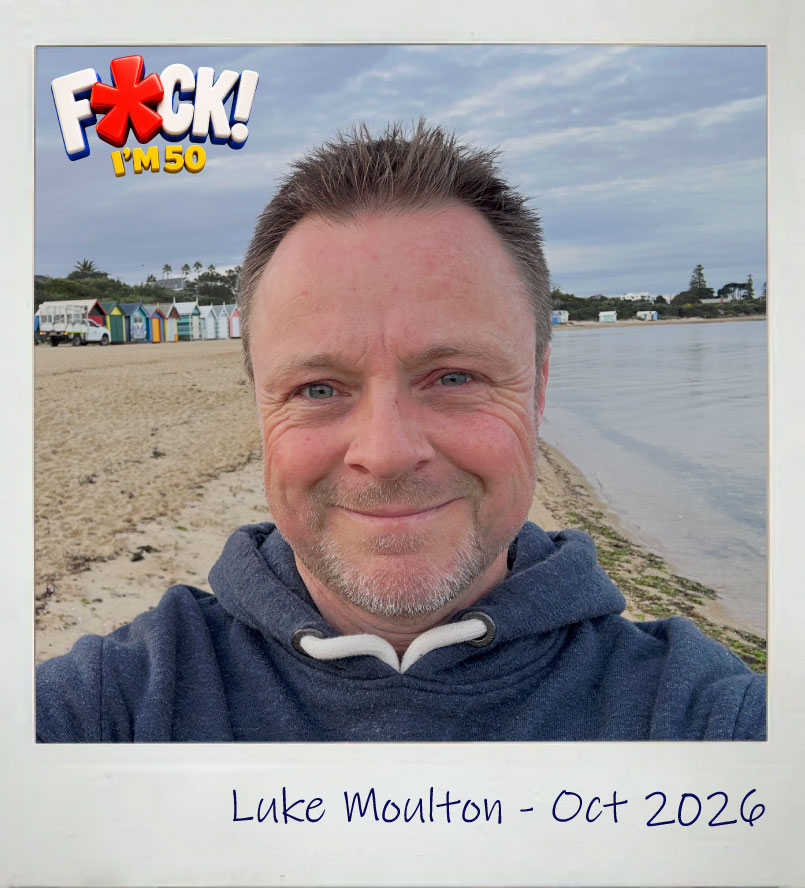
Episode 5
Luke Moulton: Creating a Life You Don’t Want to Escape
At the centre of the conversation is a powerful idea: creating a life you don’t want to escape from.

Listen to the episode
About this episode
Luke Moulton has spent most of his working life building businesses—from web development and digital marketing to running his own SaaS company.
But after divorce, a difficult period with his mental health and plenty of hard-earned perspective, success looks different at 50.
In this episode, Luke and I talk about burnout, therapy, asking for help, male friendships and why money is no longer the only measure of a good life. We also get into exercise, sleep, AI, chasing shiny business ideas and knowing when you simply don’t have the bandwidth for something else.
At the centre of the conversation is a powerful idea: creating a life you don’t want to escape from.
This is an honest chat about men’s mental health, finding purpose after 50 and making more room for the people and experiences that genuinely matter.
This is F*CK! I’M 50.
This episode includes discussion of depression, divorce and suicide.
Mental health support
If this episode raises anything for you, support is available:
About Luke Moulton
Luke Moulton has spent most of his working life building businesses—from web development and digital marketing to running his own SaaS company.
After divorce, a difficult period with his mental health and plenty of hard-earned perspective, success looks different at 50.
Transcript
Read the Episode 5 transcript
Transcript lightly edited for clarity.
Paul:
The power of having a coffee.
About 15 years ago, I reached out to a couple of guys who were running a small-business podcast. I had a little video production company, so we got together for a coffee.
Funnily enough, we all got along really well and became mates.
Our lives have since drifted in different directions, but we’ve kept in touch. We don’t talk all the time, but we keep an eye on what each other is doing.
The bloke you’re about to hear from is Luke Moulton. He has a great story, he’s a lovely guy and he’s well worth listening to.
Luke Moulton, welcome to F*CK! I’M 50.
Luke:
How are you, Burf?
Paul:
Good, mate.
Typical me—I don’t sugar-coat things. I get straight out there and say them.
I’m what I call a three-star gold member of the 50 Club because I’m 53.
I don’t actually know how old you are, but I’m tipping you’re somewhere around there.
Luke:
Thanks. Don’t sugar-coat it!
I am 50, banging on 51. I’ll be 51 in November.
When you told me you were starting a podcast called F*CK! I’M 50, I thought it sounded like a good one for blokes.
Paul:
I’ll obviously bang on about it a lot, but what has struck me from talking to you, other mates, women and plenty of different people is that everybody seems to be in this strange stage of life.
Put aside the current financial state of the world for a moment.
We spend years racing through life. Everything is happening, and then one day you wake up and think, “What comes next? Where are we going, what are we doing and how will we get there?”
Luke:
It feels like a transition into a third stage of life.
I see it in men and women around our age.
The kids are teenagers and don’t want to know you as much as they used to. In many cases, they’re already older and living their own lives.
Perhaps we’re also driven by different things.
Speaking only for myself, I’m no longer as driven by money as I once was.
I’ve become more interested in enjoying activities and pastimes that aren’t necessarily connected to the almighty dollar. They seem to give me more pleasure.
I’ve also found that they help my relationships—both romantically and with other blokes.
At this age and stage of life, it’s important to invest in those male friendships. That’s certainly where I’m finding joy.
Paul:
It’s a big, lonely world out there.
I have mates who have been through various relationship issues. They’ve found connections through cars or, in your case, kite surfing—is that what you do?
Luke:
It’s called wing foiling.
Paul:
Wing foiling. I knew it was an extreme version of hanging on for grim death.
Luke:
It’s like windsurfing with a hydrofoil.
Most people have to Google it, so I won’t attempt to explain it.
Paul:
Another death-defying activity!
But you’re saying it’s good to have something you can sink your teeth into.
Tell me a little about yourself, your working background and what you do these days.
Luke:
How long have you got?
I’ve owned businesses for most of my professional life.
I started a web design and development business in 2000 and sold it in 2007. I then worked in the corporate world for about seven years before going out on my own again as a digital marketing consultant in 2014.
I started a small and fairly niche SaaS—software as a service—business.
I’ve been very lucky with that business. There certainly isn’t a Porsche in the driveway, Burf, but it has given me the luxury of time.
I’m extremely grateful for that.
With the development of AI over the last 12 months, I’ve become much more productive in a shorter amount of time.
Rather than using that productivity to work longer and harder, I’ve recognised that I can complete more work in less time and focus on other things.
Much of that involves physical activity.
We aren’t getting any younger, and we need to look after ourselves.
Two of the best things you can do for your mental health are sleep and exercise.
I’m extremely protective of my sleep these days. I go to bed early, but I’m also up early.
I’m lucky to have found exercise I thoroughly enjoy. I spent an hour and a half on the water yesterday afternoon and about three hours out there on Sunday.
It keeps me fit and helps me engage with other blokes around my age, which is also great for my mental health.
I’ve certainly experienced ups and downs in life.
In 2018, I separated from my wife and went through a divorce.
For longer than I’d probably like to admit, I experienced a dark night of the soul. I didn’t treat myself well at all.
It took time and a fair amount of therapy to work through it.
God forbid anything like that happens again, but I’d like to think I would now have more self-awareness.
As blokes, one of the hardest things for us to do is ask our mates for help.
Sometimes you feel as though you’re whingeing or burdening them.
Asking for and finding help can be difficult, but it’s necessary if you want to move through hard times more quickly than you would trying to do it alone.
Paul:
I listen to plenty of podcasts. Anyone listening to this one probably does as well.
There’s a company called BetterHelp that advertises on almost every podcast. It’s clearly a successful business, although its ads can be bloody annoying. There’s one with a barking dog at the moment, but it cuts through, so it’s doing its job.
It becomes interesting when you think about what the service represents.
I’ve had therapy at different times over the years. I wear my heart on my sleeve about the ups and downs I’ve experienced.
Thankfully, my relationships have remained intact.
I was drinking too much at one point. I haven’t had anything for three years now, which is good. Even better, I don’t want anything.
Services such as BetterHelp show how many different ways people can now get support or simply have a conversation.
You can speak with someone online, from home, in the car, through text, on the phone or face-to-face.
Many people in our age group—and particularly those who are older—bury their heads in the sand and hope the problem will disappear.
I can speak from experience: it doesn’t.
The light at the end of the tunnel is usually a freight train.
Luke:
It’s easy to give advice when you’re in a good place mentally.
It can be frustrating to watch somebody suffer when they don’t appear to be helping themselves.
I have to remind myself what it was like when I was in that place—when I felt anxious, depressed, lonely, frustrated or upset.
When you feel that way, finding the motivation to help yourself and climb out of the hole is incredibly difficult.
Recognising that somebody you know might be going through that—and offering a helping hand without telling them how to run their life—is challenging.
We all know how to run everybody else’s life perfectly.
Paul:
Looking from the outside, you can see the solution and say, “Turn left here, go three streets down and turn left again, and you’ll be in a better place.”
But they don’t—or can’t.
You might think, “Mate, if you just did this, this and this, your life would be perfect.”
Unfortunately, it doesn’t work that way.
My brother, whom I love dearly, would tell me when we were growing up to calm down, slow down and stop stressing.
Today, they have diagnoses for all these different things—ADHD and everything else—and I’m probably a candidate for all of them.
But back then, when somebody told me to calm down, I’d think, “I can’t. That doesn’t happen.”
Luke:
Absolutely.
Neurodiversity is another part of the picture. It sometimes feels as though we’re all somewhere on a spectrum.
ADHD can make focusing difficult when your mind is constantly jumping from one thing to another.
If you’re already in a bad mental space, helping yourself becomes even more challenging.
Paul:
We’ve known each other for probably 14 years.
I’ve lived in the Whitsundays for almost 11 years, and we knew each other for quite a while before I left Melbourne.
I don’t know whether you’ll remember this, but years ago I asked you to become involved in a project. You loved the idea, but you told me, “I don’t have the bandwidth at the moment.”
That has always stuck with me.
We both come from the marketing and technology world, where we think of bandwidth as how much data can travel up and down the internet connection.
But overloading myself is probably my biggest single issue.
Although I thrive on having plenty going on, it’s also the massive speed hump constantly sitting in front of me.
Luke:
You’ve touched on something I continually need to monitor.
This week, I had to recognise it again.
In my attempt to fill life with activities focused more on wellbeing and less on money, I began accumulating too many things.
I started playing pickleball. I foil. I go to the gym.
I was going to add a tai chi class the other night, but I stopped and thought, “No, that’s enough.”
Paul:
There has to be a boundary.
Funnily enough, I’ve gone in the other direction by cutting back on work.
I have plenty to do while supporting my parents. Dad has end-stage dementia, and Mum, bless her heart, is doing everything she can.
But when you’re approaching 80 and watching your partner disappear in front of you, you can start making decisions that aren’t always the smartest.
That’s taking a lot of my time.
One of my little businesses is an airport transfer service, and I still do quite a bit of driving.
I found myself stuck in the car for eight hours on some days, with no time to do anything else.
About 12 months ago, I consciously decided to cut right back. That obviously meant reducing my income as well, but it was about reclaiming time.
I’ve since been able to develop a few smaller businesses, which is what I’ve always done best.
I throw them against the wall, see what works and keep going. As I use the extra time, the income streams gradually begin building again.
Luke:
That’s something I do as well.
If I look at the last month, I’ve started two new websites.
An idea arrives, and I’m prone to chasing shiny objects. I need to recognise that tendency.
I use Claude as my AI assistant. One of its primary instructions is: “I’m prone to chasing shiny objects. Try to recognise when I’m doing it and bring me back to my core business.”
It does that very well—sometimes frustratingly so.
Occasionally, I want to tell it, “Just entertain me for a while.”
Paul:
Just pretend it’s a good idea for five minutes!
You chase shiny objects. I sometimes think I chase parked cars.
I go racing down the road and—boom—straight into the back of one.
Luke:
What we’re really discussing is trying to find that elusive balance.
For me, much of that comes down to self-awareness.
I can now recognise when I’m beginning to burn out or heading towards burnout.
With AI, I sometimes feel like that drinking-bird toy from The Simpsons. Homer uses it to keep pressing a button at the nuclear power plant.
Sometimes I feel as though my entire role is pressing the “yes” button so Claude will continue.
When I realise I’m getting things done solely for the sake of getting things done—and I’m no longer engaged or enthralled by the work—it’s time to step back.
I need to cut down or redirect my energy towards something I find more enjoyable while still achieving a creative or, hopefully, financial outcome.
Paul:
We all have bills to pay, so the financial outcome still matters.
We’ve both been through periods in business where success was measured by financial gain—a Porsche in the driveway or whatever it might be.
I’ve been guilty of that before and probably will be again.
But there’s also the question of picking yourself up after things go wrong.
I saw a great video today. I don’t know whether it was staged, but it wasn’t generated by AI.
A young bloke was walking onto a stage to collect an award at what looked like a high-school ceremony. He tripped in front of his classmates and the entire school.
He was lying there, but he was clearly the school athlete or something similar. He pushed himself into a handstand.
He turned falling over into a handstand, flipped himself back onto his feet, cheered to the audience, did a backflip, accepted the award and walked off.
The caption said something like, “It isn’t about how you stumble; it’s about how you get up.”
Whether it was staged or not, I don’t care. It was brilliant.
It’s one of those videos you save on Instagram and never look at again.
Luke:
There’s always that saying about how you get back up.
But we also need to remember that, depending on where somebody is mentally, getting back up can be extremely difficult.
We need to recognise that, support other people and recognise it within ourselves.
Being able to ask for help is so important.
I know I’m harping on it, but last year, a bloke I went to school with—somebody I considered very successful and who was around our age—was in a bad place.
He didn’t ask for help, and now he’s no longer with us.
That isn’t an isolated story. We’ve probably all known somebody or heard of somebody in that position.
You can’t come back from that.
Paul:
It’s permanent.
Men often seem reluctant to ask for help.
Women may talk among themselves but don’t necessarily seek professional support either.
That’s a broad observation from my personal experience—not clinical information by any stretch.
It’s part of why I wanted to make this podcast.
There’s obviously an egotistical part of me that simply wants to say what I want to say.
But the bluntness of the title represents what the show is about.
You reach this stage of life and think, “Fucking hell. How do we get up every day and make it worthwhile?”
My philosophy is that if the sun comes up and I still have a heartbeat, that’s the starting point.
Then we work out where to go from there.
Luke:
It’s something I’ve spent plenty of time thinking about.
One idea I keep returning to is creating a life you don’t want to escape.
For me, that means filling it with people you enjoy being around.
When I first married, I made the mistake of moving to a fairly rural area, secluded from family and friends. That wasn’t good for the relationship at the time.
It took me a long time to recognise the importance of surrounding yourself with community, family and friends.
If you can’t live close to family, find ways to engage with and become part of your community.
That provides a sense of purpose.
Purpose is something many of us begin searching for when we realise we’re 50.
Perhaps the job no longer fulfils us. The kids aren’t as interested in us anymore. We might be struggling with our partner.
Finding meaning outside—or in addition to—those parts of life is incredibly important for mental health and wellbeing.
Paul:
You’ve touched on an important subject and one of the central purposes of this show.
I’d love to hear from anybody with a story they want to tell.
Even if somebody simply wants to talk and needs a shoulder to lean on or an unbiased person to listen, I’d like to hear from them.
I’d also love to catch up with you again in about six months and see how things are going.
Perhaps we can talk more about your wing-foiling group, and you can explain what it feels like to stand on a two-metre piece of fibreglass with a razor blade underneath it in 100-kilometre-an-hour winds.
Luke:
I’d be happy to bang on about that for a few hours, Burf.
Paul:
Thanks very much for joining us.
I really appreciate you giving us your time, talking openly and putting your heart on the table so we can all learn from your experiences—the good and the bad.
Well done, mate. I think what you’re doing is a great way of looking at life.
Luke:
Thanks, Burf.
Good on you for starting this podcast. It’s a great topic, and I think it will help other people.
It was good chatting with you.
Paul:
You, me and the other three listeners will be very proud, mate.
We’ll talk again soon.
Luke:
Cheers, mate. See you.
Paul:
It’s always great to catch up with Luke.
The funny part of this story is that we tried to meet during several of my trips to Melbourne, but it never happened because life kept getting in the way.
We eventually recorded this one remotely, and it worked pretty well.
I have a few more guests lined up, along with a couple of things I’d like to talk about myself.
Like, subscribe and do all those good, fun things.
I’m Paul, and this is F*CK! I’M 50.
Thanks for hanging around.
Mental health support
If this episode raises anything for you, support is available: