

Episode 4
Nancy D’Agostino: Finding Yourself After Putting Everyone Else First
This is a conversation about following your own path, finding yourself again and refusing to reach the later years of life wondering what might have happened if you’d had a crack.


Listen to the episode
About this episode
Nancy D’Agostino is a mum, wife, singing teacher, author, illustrator and performer. Yep, there’s a lot going on.
But behind everything Nancy has achieved is a story about family expectations, responsibility and what can happen when years of putting other people first leave you wondering where you went.
Nancy grew up working in her family’s furniture business and studied accounting because it was the secure path her parents wanted for her. Quietly, though, she kept pursuing the thing she truly loved: singing.
We talk about building a career as a singing teacher, raising a family and spending years helping care for ageing relatives. By the time Nancy reached 50, she had a beautiful family and a successful teaching career—but still felt that something was missing.
She had spent so long caring for everyone else that she felt she had lost part of herself.
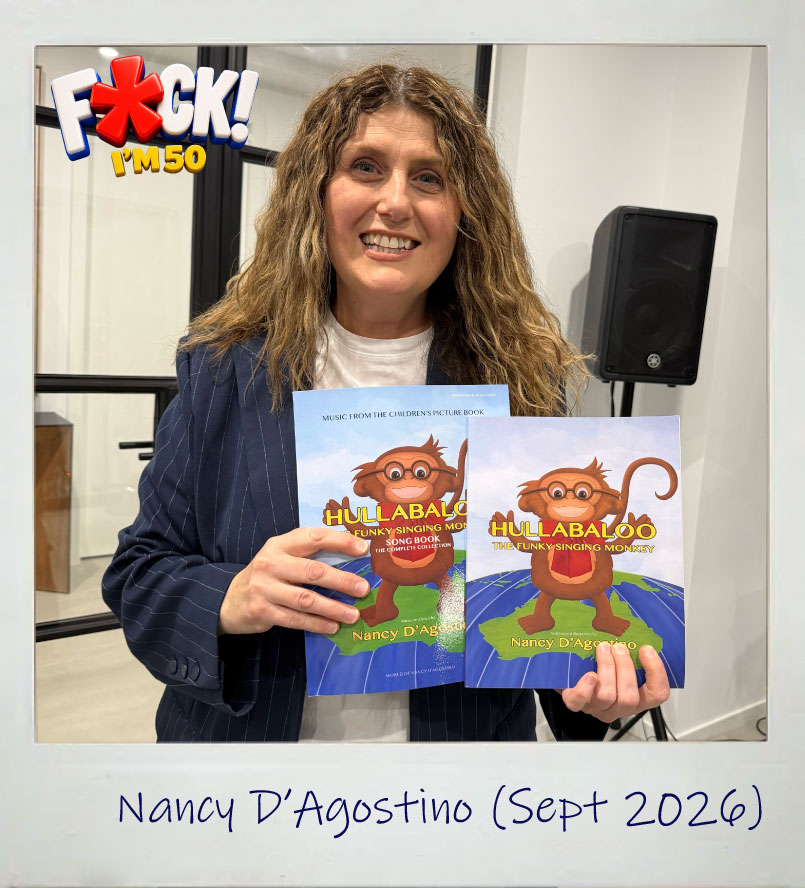
Nancy shares how she finally drew a line, made room for her own ambitions and began turning decades of ideas into something lasting. That creative drive led to her children’s book series, Hullabaloo – The Funky Singing Monkey, along with her work as an author, illustrator and recording artist.
This is a conversation about following your own path, finding yourself again and refusing to reach the later years of life wondering what might have happened if you’d had a crack.
Find out more about Nancy and her work at https://worldofnancydagostino.com/.
This is F*CK! I’M 50.
About Nancy D’Agostino
Nancy D’Agostino is a mum, wife, singing teacher, author, illustrator and performer.
Nancy grew up working in her family’s furniture business and studied accounting because it was the secure path her parents wanted for her. Quietly, though, she kept pursuing the thing she truly loved: singing.
That creative drive led to her children’s book series, Hullabaloo – The Funky Singing Monkey, along with her work as an author, illustrator and recording artist.
Find out more about Nancy and her work at worldofnancydagostino.com.
Transcript
Read the Episode 4 transcript
Transcript lightly edited for clarity.
Paul:
G’day, it’s Paul, and welcome back to the show.
This week brings the second in our series of interviews. My guest is a wonderful, highly intelligent and very creative woman from Melbourne: Nancy D’Agostino.
Let’s jump straight into it.
Nancy, tell me a little about yourself. You’re a singing teacher, author, mum, wife and illustrator.
You’re what I call a seven-star member of the 50s Club. I’m a three-star member.
Nancy:
I didn’t know there were seven stars.
Paul:
There are actually 10.
You’re 57—is that correct?
Nancy:
Yes.
Paul:
That makes you a seven-star gold member. I’m 53, so I’m a three-star gold member.
That’s my calculation.
Nancy:
It’s hard to believe.
There was one year when my dad was really sick and we didn’t celebrate my birthday. It was as though that year never happened.
The following year, I can’t remember how old I was, but I remember thinking I was a year younger.
A doctor asked my age. I told him, but he worked it out and said, “No, that isn’t right.”
I insisted it was.
It was as though I’d dismissed that whole year.
That’s an example of what happens when you have a lot going on. Everything else takes priority, and you take a back seat.
Paul:
Before we started recording, we were talking about your 30-odd years in singing.
Your background was in the family furniture and retail business, which wasn’t really your passion. Singing, entertaining and performing were your passions.
Then you had children, marriage and all those other good things.
You’ve now reached a point where you’ve said, “There’s something about me here as well.”
Your family is a very big part of the picture, but you’re making a big push for yourself—and everyone is supporting you in different ways.
We’ll talk about that.
What I loved about our first conversation a few days ago was that I could sit back, let you go and listen to you teach us all about motivation.
You’re what I call a pocket rocket.
You have so much motivation, and it’s great to see. Plenty of people in our age group wake up one day and wonder where all the time went.
That’s where the name of the show came from.
You mentioned losing an entire year without really noticing because so much was happening.
Tell me about your singing and teaching. Then I want to talk about your book because you have a lot going on.
Nancy:
There’s a lot going on.
I grew up with both my parents working. Mum worked at Pelaco, sewing shirts, I think. Dad worked in a clerical role at Rothmans.
That was great for us because it was a large company with plenty of money in those days. We went to Christmas parties where Santa gave us presents.
Eventually, my parents had an opportunity to open a furniture store. They initially leased it, then bought it and ran the business themselves.
I was seven years old.
The student who just left my studio was seven. At that age, I thought I was so grown-up. Looking at how young she is, I now think, “Oh my God, that was a very long time ago.”
Growing up in the family business, I wanted to do everything I saw the adults doing.
For me, it was about making the sale, giving the biggest discount and organising the delivery. My parents were always there for me to check with, but at seven, eight, nine and 10, I was essentially doing what I saw them doing.
It gave me a sense of independence and the belief that I could make things happen.
Rather than working for somebody else, you simply opened your own business. That was what you did.
Paul:
I relate to that completely.
Nancy:
That attitude stayed with me.
But when it came to training my voice, there was a big hiccup.
Mum loved singing, but Dad was afraid of the entertainment industry. He didn’t think it was safe for me.
I was the first child, female and from an Italian family.
I sang all day. My grandparents supported everything I wanted to do with singing and knew where I was performing.
It was more difficult with my parents, particularly Dad. He was a very modern man, but he was trying to protect me.
Paul:
Entertainment has never really been considered a stable source of income.
Nancy:
There was also the idea of sex, drugs and rock and roll. That didn’t go down well.
I was brought up to be reserved, polite and respectful.
When you’ve lived that way your entire life, it’s difficult to suddenly stop. You’ve climbed that mountain, so why would you give it up for someone?
If people expect you to drop everything simply to be normal, you think, “I haven’t been normal my whole life. Why would I change now?”
Eventually, I convinced my parents to let me take singing lessons.
It was a commitment, and I loved and looked forward to it. I trained for more than 12 years.
It wasn’t as though I took 10 lessons every week, but I practised for six hours every day, including weekends. I couldn’t stop.
My parents didn’t want me to perform, so I performed quietly whenever I could and didn’t make a big deal about it.
My grandparents knew when I was performing at places such as Café Clicquot, Stylus or Silvers. Dad didn’t really know where I was going. I would leave early and say I was going to dinner.
Paul:
The funny part is that you weren’t out smoking dope or doing anything wild.
Nancy:
It all happened anyway!
Eventually, I reached the point where I had to study accounting at university because that was what Dad wanted.
I wanted to study fashion design. There weren’t many singing courses available at the time.
I was accepted into fashion design, but Dad begged me to defer it and take the accounting course instead.
There’s more to the story, but I’ll keep it brief for this podcast.
I did the accounting course and absolutely hated it.
I like business, but I didn’t enjoy debits and credits.
Paul:
There isn’t much creativity in it.
Nancy:
I was dying.
The classes were mostly boys, with perhaps one or two girls. I became the person cracking up the class.
I felt as though I could light up the room, but I was displaced.
I continued taking singing lessons on the side.
Dad still didn’t want me to do it, so I found a middle ground and a way to get through to him.
I said, “What if I became a singing teacher? Every parent—including every Italian parent—could send their child to that teacher. That teacher would be your daughter, and you know you brought her up well, so it would be okay.”
He couldn’t argue with that.
It took time and plenty of tears, but eventually he took me to my first singing lesson. It never stopped from there.
By the time I was 18, I was paying for my own lessons.
I worked in the furniture store until I was about 18 or 19 and never got paid. That probably wouldn’t be legal these days.
But when I turned 18, my parents bought me my first car: a brand-new Nissan EXA twin-cam sports coupé worth about $26,000 or $27,000.
Paul:
Those little EXAs were great cars.
Nancy:
If I had been doing everything because somebody was pushing me, I probably wouldn’t have done it.
I did it from the goodness of my heart. When there were no customers in the furniture store, I would be singing.
Paul:
Although the family guided you down that path, you learned some incredibly important things.
You learned sales, management, logistics, taxation, finance and money.
At the end of the day, if something costs you three dollars, you have to sell it for 10 to make money.
Nancy:
Those lessons continued.
I didn’t finish the accounting course. I was struggling to continue, so Mum suggested I find a job in that area and see whether I liked the work.
I found a position at a law firm on Bourke Street, assisting the accountant and working alongside some of Melbourne’s best lawyers.
The firm set the bar extremely high. They sent employees to coaching and entrepreneurial courses.
Today, we have gurus everywhere, but this type of training was unusual then. The firm must have spent a lot of money putting its employees through those courses.
When I left, I took all my notes with me. I probably should have left them behind, but I knew they were important.
I never forgot what I learned.
That added another layer to my foundations and raised the bar.
I hadn’t planned to teach singing, but the opportunity came along and I began teaching.
I was young and still a little shy.
Paul:
How young are we talking—early twenties?
Nancy:
Very early twenties.
I remember wearing a black suit with my hair in a bun, trying to look 30 when I was only 21 or 22.
Nowadays, people sometimes say I look 30, 35 or 40.
Paul:
You definitely don’t look 57.
Nancy:
Sometimes I forget I’m 57.
It isn’t only about appearance. It’s about mindset, motivation, what you do and the people around you.
While I was building my life, three of my grandparents became unwell with Alzheimer’s disease over a period of nearly 15 years or more.
Then Dad was diagnosed with a rare form of leukaemia. We kept him alive for almost 10 years, although the illness would usually have progressed much more quickly.
People with Alzheimer’s can sometimes be gone within a few years, but my grandparents each lived for about 10 years, largely because of Mum.
We helped her, but she took on the central caring role.
Paul:
It’s draining.
You also had a husband, young children and a business to run.
Nancy:
And the most beautiful dog.
All of that was incredibly difficult to navigate.
The hardest part came when I was around 40. I hit a roadblock.
You talk about reaching 50, but for me it happened at 40. I felt disappointed.
By then, I had hoped to publish a children’s book and release my own singing project.
Paul:
We won’t give away the name yet, but you’re working on your own singing project.
We can revisit that in another episode.
Nancy:
When my grandparents began getting sick, I was about 30.
I remember thinking, “What if something happens to me?”
The methods and techniques I had developed wouldn’t exist anywhere. They would be lost.
I decided to create something permanent and wrote a training manual.
It started small, covering vocal technique. Then it expanded into performance and stagecraft, songwriting, artistry and artist development.
Eventually, the manuscript was as thick as a ream of paper. It was fully edited and probably 90 per cent complete.
I had an editor working on it, but I received some backlash from people in the music industry, including teachers and others working in the field.
People would say, “At your age, should you be publishing a book like that?”
They believed you should wait until you were 60 and ready to retire because you would then have enough experience behind you.
But the book meant everything to me. I didn’t want that knowledge to be lost.
In the end, it was never published.
Paul:
Was that because you felt ostracised by the industry?
Nancy:
It became nasty and vicious.
It was like imposter syndrome. I lost confidence and began asking myself whether I had earned the right to do it yet.
I knew I was capable, but I still questioned myself.
Paul:
That period between 40 and 60—with the fifties in the middle—is interesting and sometimes troubling.
It affects both men and women. Women experience particular physical and health changes. Men have plenty of their own, although nothing quite as severe.
We’re also worrying about our partners and everything else happening around us.
It’s a very strange stage of life.
Nancy:
At 40, I thought, “I should already have done this.”
I had been thinking about it since I was 30, so I told myself, “This is it. I’m going to do it now.”
But by 40, your grandparents are ageing and things begin happening.
Dementia became a major part of our lives.
Paul:
It has recently overtaken heart disease as a leading cause of death among Australians.
Nancy:
That’s incredible, sad and concerning for everybody.
My forties were shaped by all these events.
It began with my grandfather, then my grandmother and eventually my other grandmother.
Poor Mum didn’t want to place them in nursing homes. She went from running the family business and working professionally alongside Dad to suddenly becoming a full-time carer.
At the same time, I was having children—even before my brothers had children—and Mum was trying to collect them from school while I ran my business.
Everything became crazy.
Your own needs get pushed aside, and you lose yourself.
Then Dad became sick just after my second child was born.
I was running a business, raising two children, helping with grandparents who were still unwell and dealing with Dad’s diagnosis.
It felt like an avalanche with no end in sight.
The people you expect to be around often aren’t.
There’s a saying that people may be in your inner circle, but they aren’t necessarily in your corner.
I didn’t fully understand that until the last few years, particularly while publishing my children’s books.
I had encountered the concept in entrepreneurial courses and studied entrepreneurs who achieved extraordinary success.
But I don’t want to sell myself in a way that feels inappropriate. I don’t want to do something simply to make money.
I want to make a difference and leave a legacy.
My parents ran a business that ended when the business closed. It wasn’t a legacy.
While Dad was dying, it became even more important to create something of my own that would remain.
The singing is inside the children’s book. It includes scales and a Rhyme Stone. It’s an entire ecosystem of products people can use—whether they want to sing, be happy or simply experience the story.
I feel I’ve created something good.
If something happened to me tomorrow, I would still be alive within it.
Paul:
Tell me about the book. What is it called?
Nancy:
The book is called Hullabaloo: The Funky Singing Monkey.
I had originally begun writing a children’s series called Oscar and Claire, based on my children but using different names.
The storylines don’t completely reproduce what happened in our family, but they grew from my stories.
I worked on it while everybody was sick. Eventually, I reached a point where the first book was almost finished and needed professional illustrations, formatting and production.
Then I panicked.
It was the same panic I experienced at 30 when I wanted to publish the singing manual and people said I was too young.
The fear came back.
I thought, “I need to test the waters. I need to become an author without beginning with the series containing elements of my children and family.”
I decided to write and publish a smaller book first. That would teach me what needed fixing before I tackled the larger project.
But I can’t do anything by halves.
I wrote the manuscript and began what became a massive process.
I signed with a ghostwriting company that was supposed to turn my illustrations into digital artwork.
That story is for another interview. I’m technically still working with the company, although I now have my own graphic designer.
It was—and remains—a nightmare. Eventually, I had to take matters into my own hands, while continuing to pay the bills along the way.
Working with Paul Miller from Paul Miller Illustration and Design, I was able to repurpose and repair the original PDF files.
Because the underlying artwork was high quality, we managed to publish the first book in multiple formats.
I also produced a songbook, colouring book, a single that I sang, two albums matching the songbook and children’s book, and an instrumental album.
This isn’t about promoting myself or trying to make millions of sales. I’m not focused on marketing at the moment.
I want to complete and release all the products first so people can experience them.
While working on Hullabaloo, I had a dictionary in front of me. I love reading dictionaries. They’re my favourite books.
I like seeing words separated so I can decide what to do with them.
I decided I was going to write another book.
I picked up the dictionary, split it in half, closed my eyes and placed my finger on the page.
When I opened my eyes, the word was “hullabaloo.”
I didn’t know what it meant.
I read the definition and recognised the similarity to my own life. I didn’t like how it made me feel.
A hullabaloo can mean complete chaos—when your life is upside down and nothing feels right.
I had lived through nearly two decades of that.
I remember when my children were in primary school. Everybody else seemed happy while I travelled between nursing homes, Peter MacCallum Cancer Centre, St Vincent’s Private Hospital and home—all while running my singing schools and managing everything else.
I wondered, “Why is this happening to us? We’re good people. We’ve done everything by the book. What did we do to deserve this?”
A doctor at Peter MacCallum once told me, “Every family will go through this, but the timeline is different. It’s unfortunate that everything has happened bumper to bumper, like a domino effect, in your family.”
Things eventually improved and life was good again.
Then Mum became sick, and it all started again.
She’s now in a nursing home where she’s being cared for. She can’t walk, but she’s doing well.
I’ve reached a point where I have my life back.
My teaching is back on track, and I teach five days a week. I have my publishing work and my own company, World of Nancy D’Agostino.
I have time for my family and can catch up with friends.
But I’m very disciplined. I work hard to balance everything.
Paul:
You’ve levelled out your hullabaloo.
Nancy:
Yes.
Although the first meaning made me uncomfortable, I knew the word connected with me.
I ran around the house looking through different dictionaries.
I found one my brother had used at school, with his name scribbled inside. I looked up “hullabaloo” in every dictionary and found slightly different definitions.
One definition described it as a celebration of life.
That was the one.
I thought, “Oh my God, that’s it. I’m going to write a book called Hullabaloo, and it will celebrate life.”
Instead of focusing on death and illness, I would celebrate life’s beauty.
Dad wrote beautiful love letters to Mum and loved poetry.
At school, I felt disconnected. I didn’t want to read in front of the class because my face would turn red.
I wanted to sing, but only behind closed doors. I was shy.
Through my work and constant learning, I’ve experienced tremendous growth. It has allowed me to become a force of nature.
I now feel I can do anything I put my mind to.
Motivation is incredibly important.
During COVID, I wrote a book called Singer’s Mindset Secrets. It hasn’t been published yet.
It began as a series of blog posts. Those posts became chapters, and I continued expanding them.
The book covers archetypes, how you spend your time, learning to see what is in front of you and connecting the dots.
All those things make a difference in life.
In private lessons, I mentor students in areas beyond singing because singing can’t work on its own. You need to be more than that.
Coaching is important.
Paul:
That goes back to being seven, eight, nine or 10 and working with your parents in the furniture store.
Those early experiences become part of who you are.
Nancy:
Exactly.
Many of my students don’t have that background. When I explain something unfamiliar, they can sometimes take a step back.
I give them the tools they need to build their confidence layer by layer. Eventually, you can see that confidence coming out of them.
It makes an enormous difference.
Talent alone doesn’t guarantee that somebody will succeed.
From what we’ve learned through teaching, a naturally talented person can sometimes be less likely to succeed because they haven’t developed the commitment and drive to persist.
They don’t pivot. They expect success to come easily, and if it doesn’t, they give up.
Years later, the person who lacked the natural ability but kept working, chiselling and developing good technique often gets there.
The others fade away.
Paul:
It’s the rough-diamond idea. You polish the diamond and make it shine.
Nancy:
It’s funny you should say that.
My first school was called White Diamonds School of Modern Singing.
My teacher told me I was a diamond in the rough and that he was polishing me.
My first band was called White Diamonds. Then I established White Diamonds School of Modern Singing and another part of the business called White Diamonds Music Management, where we worked in artistry and artist development.
The business continued evolving.
Today, the Institute of Singing is a private studio in Keilor.
I get to spend every day doing what I love and helping shape people’s lives.
Paul:
We’re recording in your home studio, and it’s stunning.
There’s a beautiful black grand piano, six or eight microphones on the wall and mirrors that almost make it look like a dance studio, allowing students to watch themselves sing.
Nancy:
My studios have traditionally had wall-to-wall mirrors attached to the plaster.
We’ve moved studios over the years, and I hated having to leave those mirrors behind or break them.
Now we have elegant, minimalist, metal-framed mirrors that can move with us.
Paul:
I love that you’ve built this inside your home.
You told me earlier that it completes you.
We walked through the front door and came directly through the glass doors into the studio and office.
You’ve put so much of yourself into every element.
Nancy:
My real advice—and what I’m passionate about—is that when you reach a certain age, you need to consider what is still missing.
When I reached 50, I was teaching and appeared to have everything. I was married, with a beautiful car, husband and children.
But something was missing.
I had given so much of myself to caring for my grandparents, Dad and now Mum that I felt I had lost myself.
I only felt complete when I was teaching a singing lesson, standing on a stage, working in my art studio, illustrating my book or rewriting a manuscript.
I produced 100 versions of the first manuscript because I needed it to read as though I had been writing books for 50 years.
I needed it to be perfect.
Sometimes you have to create something enormous and then strip it back. That’s part of your own growth and development.
My original dream was to perform and become a superstar, but that wouldn’t have aligned with the family life I wanted.
The next path was teaching. I loved it and contributed a great deal to the study of voice.
At this stage in my life, feeling complete means being a mum, managing my home, maintaining a professional space where I can teach, publishing my work and continuing to sing.
More importantly, I need to feel that all those boxes have been ticked.
I knew doing everything might be impossible. Most people are lucky if they can do one thing.
But I believed I could do everything if I worked hard enough.
My husband always says, “Finish what you start.”
Paul:
There will always be something new coming because that’s your nature.
Nancy:
I never want to be finished.
This is who I am and what I do. I don’t intend to ever be finished.
I’m sure there will be projects left incomplete when I’m gone. But if I can leave more behind, that is my gift to the world.
It’s a world of singing.
It’s inside every part of me, and it extends into life.
Not everybody understands that same level of passion, so sometimes you need to switch it off or put it aside, depending on who you’re with.
When you’re in your own element, you thrive.
But it took a long time to reach this point. Nobody should think I achieved it quickly or easily. It required complete commitment.
I’m 57.
People sometimes say, “You’re so lucky. What you’ve achieved at your age is amazing.”
The reality is that I’m 20 or 30 years older than some of those people. Let’s see where they are after another 20 or 30 years.
If you sit around doing nothing, it won’t work.
There were 20 years or more that felt wasted.
Eventually, I had enough. I drew a line and said, “I’m going to make a difference. I’m going to fit 10 years of work into one year, tick every box and get it done.”
I stopped caring what anybody thought.
I didn’t care if I couldn’t be there for everybody for a little while. I needed to complete this for myself.
I had given enough, and enough had been taken from me.
When you begin achieving those things, it isn’t about money. It’s the achievement of placing “author,” “illustrator” and “recording artist” alongside my name.
I’m also a singing teacher—not simply a vocal coach.
I created the Vocalology Methodology, which I protected and trademarked decades ago. It has continued to evolve and will eventually become part of my books.
It provides a foundational technique for singing, and that makes my own foundation rock solid.
My publishing work isn’t solely for me. It’s something I want to leave behind and give to others.
Paul:
But it was still an itch you needed to scratch.
Nancy:
It made sense.
I’ve always loved Disney, poetry and rhyme. Publishing connected all the dots.
Paul:
It returns to that need for a creative outlet.
Nancy:
I feel as though I can have everything, but it isn’t a conventional life.
We spoke on the phone yesterday about how my husband sees things in black and white. He’s a pilot and an auto electrician.
Something either works or it doesn’t. You’re going in the right direction or you aren’t.
The creative side—the dreams, passion and drive—is completely different.
You said there isn’t simply a grey area. There’s every colour of the rainbow in between.
That’s where I am.
Hearing it described that way allowed me to own it. I’m allowed to have all the colours and the entire spectrum.
People sometimes say artists need to sit a little to the left or right of the spectrum. If you’re directly in the middle, perhaps you aren’t really an artist.
You need to be slightly unhinged in some direction—but not so far that it becomes unhealthy.
Paul:
It’s funny you mention wanting to achieve something.
This podcast is something I wanted to do for years. I needed to find something meaningful to build it around.
I’m not interested in using it to sell a service. I might advertise some of my own products, but whether the show grows or it doesn’t, this is something I want to leave behind.
I completely understand where you’re coming from.
Before we wrap up, you mentioned worrying that your family might not support what you wanted to do and that making time for yourself meant taking time away from them.
As listeners now know, I know your husband through aviation. I originally spoke to him about appearing on the show because he teaches people to fly.
He said, “You know what? I know a little pocket rocket you should talk to.”
He has your back.
You’re an inspiration, and I hope listeners take the opportunity to find your book.
Where can they find you online?
Nancy:
For my publishing work, visit worldofnancydagostino.com.
For singing and vocal training, visit instituteofsinging.com.
The two websites link to each other, so you can move between them.
There’s one more thing I want listeners to understand.
I dress nicely for my students because I want to make each lesson feel special.
But I’m also a normal, natural person. The professionalism and respect are always present, but when I finish teaching, my students know the first thing I do is run upstairs, change into a tracksuit, remove my makeup, put my hair up and return to being Mum.
That’s the beauty of it.
You don’t have to feel as though you’re performing every minute of the day.
Do what you do, do it well and work hard.
Don’t rely on other people to cheer you on or push you towards your dreams.
Start small. Find someone who can help and take little steps. Don’t give up.
If you do, you’ll be like the 90 per cent of people who reach a certain age and find themselves unhappy.
If you’re struggling with your mental health, seek appropriate help. But also consider singing lessons, finding a hobby or doing something that brings you happiness.
Find the things that allow you to connect with the spirit, soul and happiness within yourself. That happiness can spread through the rest of your life.
It doesn’t need to occupy you 24 hours a day.
I’ve learned to balance my life by switching between its different parts.
I can be an author one minute and a mum the next. I can go out with friends without doing my hair or makeup and not care who sees me.
I can also dress up when an occasion requires it.
I make everything work because I’ve learned to do it bit by bit. Ultimately, it’s up to me.
My approach is always to return to the basics and strip everything back.
When students are developing their singing technique, we work through the craft line by line.
But a singer should eventually be like a tradesperson who has the tools and knows how to use them. They should be able to go out and do the job.
You don’t need to begin with perfect technique. Almost anybody can sing.
Paul:
Then you improve from there.
Nancy:
Exactly.
Many people search online, find something on YouTube and attempt to copy it without ever having a singing lesson.
That can lead them in the wrong direction because they don’t know how to assess what they’re doing.
Even one or two lessons can provide so much clarity and inspiration that your future becomes different because of them.
Paul:
That returns to the idea of asking for help.
If there’s something you want to achieve, have a go. You’re proof of that.
Nancy:
Absolutely.
Don’t reach 80, sit in a rocking chair with your grandchildren on the rug and find yourself unable to answer when they ask what you did with your life.
Treat your time as carefully as you treat the money in your wallet.
I know people who go away on holiday every school term and spend enormous amounts on travel.
I’m often too busy to think about a holiday.
But if you’re doing something you love—even if you can’t do it full-time because we all need to earn a living—put aside some time each week for it.
Spend part of your personal time working towards your own growth.
You’ll be happier, your life will feel more balanced and you’ll become a better person with fewer regrets.
It doesn’t need to be a major undertaking such as publishing a book.
It can be something as small as planting something, watching it grow, talking to it, showing it to somebody, cutting off a few flowers and giving them to a neighbour.
Little things go a long way.
If you notice them, they enrich your life. If you don’t, they pass you by.
Paul:
Nancy, thank you very much for being on the show.
Nancy:
Thank you.
Paul:
We were in the car the other day with your daughter when I dropped the F-bomb while explaining the show.
Nancy:
That word can be a little much for me, particularly because I work with children’s books and teach kids.
Paul:
The name is intended as a reminder for all of us: this is happening, we’re here and it’s time to get on with life.
It’s meant in jest.
Nancy:
I think creating this show is a great thing for you.
For me, it relates to the moment when I learned to pivot.
Paul:
That was a really interesting conversation with a woman who has put her heart and soul into following her dreams.
Good on her. It’s a great thing to do.
Coming up soon, we have Luke Moulton, a mate of mine from Melbourne with experience across marketing, SaaS—software as a service—and plenty of other areas.
Luke talks about his ups and downs, reaching 50 and what comes next.
Stick around, come back soon, and remember to like and subscribe.
This has been F*CK! I’M 50.
I’m Paul. If you’d like to be part of the show, flick us a message. I’d love to have you on.
I’ll catch you soon.