


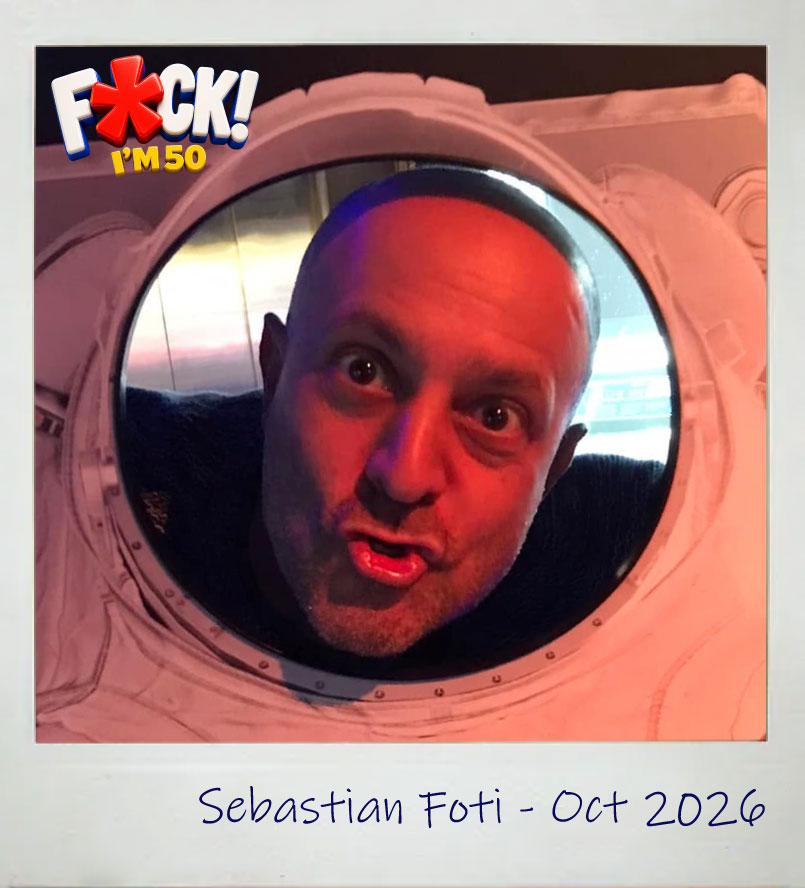
Episode 6
Starting Over After Divorce: Sebastian Foti on Fatherhood, Career Change & Midlife
After more than 20 years of marriage, Sebastian Foti found himself navigating divorce, raising three teenage children and rebuilding his life as he approached 50.


Listen to the episode
About this episode
After more than 20 years of marriage, Sebastian Foti found himself navigating divorce, raising three teenage children and working out what the next part of life should look like as he headed towards 50.
In this episode of FI50 — F*CK! I’M 50, Paul Burfitt sits down with his longtime mate on the waterfront in the Whitsundays, Queensland, for a candid conversation about starting over after divorce, fatherhood, friendship, career change and finding a better balance between work and life.
A mechanical engineer who has spent much of his career in mining, Sebastian talks openly about the end of his marriage, becoming a single parent, the importance of having people to talk to and why honest advice from good friends helped him through a difficult period.
They also talk about Sebastian’s decision to leave a demanding job filled with long hours and work travel for an even-time remote mining roster — giving him more genuine time with his children and more space for the things he enjoys.
Cars are a big part of that life. Sebastian discusses restoring and building classic Fords, his involvement with the local Whitsundays car community and the annual car show at Coral Sea Marina in Airlie Beach, as well as why working on cars has become both a passion and a useful escape from everyday stress.
The conversation moves through investing and financial regrets, parenting teenagers, being more present with family, redefining success in midlife, qigong meditation, salsa dancing and the value of deliberately doing things outside your comfort zone.
Most importantly, Sebastian comes back to one simple lesson from his own experience: if you’re struggling, talk to someone — and if you see someone else struggling, take the time to listen.
A genuine conversation about divorce, midlife change, fatherhood, work-life balance, friendship and discovering that starting again doesn’t mean starting from nothing.
This is FI50 — F*CK! I’M 50.
Transcript
Read the Episode 6 transcript
Host: Paul Burfitt
Guest: Sebastian Foti
Location: Whitsundays, Queensland, Australia
Podcast: FI50 — F*CK! I’M 50
Paul Burfitt:
A good mate of mine has been through some major hurdles over the last five years, and that really started, I guess, when his marriage — for no easy way of saying it — fell apart.
He and his wife decided that it just wasn’t working and they moved on after, whatever it was, 20-odd years of marriage and three teenage kids at the time.
Sebastian and I have probably got a little bit closer over that time. We were mates through the kids and through our wives and things like that, but we’ve probably got to know each other better just through being there to chat.
Definitely good mates. We talk cars, and I hope I’ve helped him, and he’s definitely helped me with different things in life.
So I thought, what better way to find out more about Sebastian’s little adventures as he heads towards 50?
We sat down on the beachfront here in the Whitsundays and had a bit of a chat.
So this is Sebastian Foti.
Sebastian Foti, welcome to F*CK! I’M 50.
Sebastian Foti:
Thanks, Paul.
Paul:
You know me, mate. Never subtle.
Sebastian:
Never subtle.
Paul:
You know, it’s a funny thing actually, because a couple of people have, I guess, pushed back on the name of this show.
Sebastian:
Oh, it is an interesting name.
Paul:
Well, the whole idea is it’s meant to be a bit in your face.
Sebastian:
Which it is.
Paul:
It is, yeah.
But it’s interesting because some people are like, “Oh, you can’t swear. You can’t swear.”
My wife and I — Deb, who you know obviously — were watching MobLand last night. I counted 11 times they dropped the C-bomb in the most popular show on TV at the moment.
Come on. I’m just using the little F-bomb at the start of a show.
Sebastian:
Well, that’s right. Years ago, F-bomb used to be something that they never used to say, and now the C-word crops up all the time.
Paul:
My mum used to say, instead of saying “shit”, she’d say “Schweppes”. And then if she was really pissed off, she’d say “Schweppervescence”.
Sebastian:
Escalation.
Paul:
Clearly she didn’t raise me very well if that’s the case.
Anyway, we’re sitting here down on the waterfront in the Whitsundays. Pretty shit part of the world.
Sebastian:
Oh yeah. It’s tough. It’s tough.
Paul:
Tell me a little bit about yourself. Obviously I know who you are, but tell the listeners a little bit about yourself and how we got to know each other.
Sebastian:
Well, we got to know each other when I moved over here about 10 years ago and our kids went to the same school.
They were roughly the same ages, but the two boys were the same age and in class together. I guess that’s how we got introduced.
What am I? A mechanical engineer. That’s my background.
I’ve worked in mining pretty much my whole life. Before that I was in farming. My parents farmed.
Paul:
I didn’t know you were actually in farming. I guess I sort of did, because I know your parents are into farming, but I didn’t really realise you actually worked on the farms.
Sebastian:
Bloody oath, mate.
Paul:
My farming background was when I was eight years old. I remember Dad had a Massey Ferguson tractor and we had some sheep.
In fact, I remember Dad driving his XY GT Falcon across the back paddock towing a trailer.
Anyway, that’s the things you did many years ago.
Sebastian:
That’s it.
Paul:
Speaking of XY Falcons, you’ve got your own XY GT rocket ship.
Sebastian:
Yeah, the pride and joy.
It’s not a ridgy-didge GT, but I do have an XY.
Paul:
Never let the truth get in the way of a good story, though.
Sebastian:
Exactly.
Cars are definitely my hobby, my thing.
I like to get out and drive them. I like to get out and work on them. It can be frustrating at times, but it’s always rewarding to get them up and going again and get out on the highway, cruise around a bit, listen to some music and catch up with friends.
It’s always good.
Paul:
You and I have probably become even closer over the last five years.
I guess it’s probably the last five years that you have gone through a marriage breakdown.
Sebastian:
That’s right. Yeah.
Paul:
There’s no easy way to bring it up, so cut to the chase, as always.
You’re now divorced. Single man.
Sebastian:
That is right.
Paul:
We’ve obviously had many conversations about that whole transition.
The kids still live with you.
Sebastian:
They sure do. Yep.
Paul:
And you’re doing an amazing job really being there for them and holding the burden of so many things that a lot of us do.
I guess you’ve also then thrown yourself into — I wouldn’t say a change of career — but a change of work-life structure.
Sebastian:
Yeah.
Paul:
You’re not necessarily working 70 hours a week, 10 minutes down the road from home anymore, but you are away week-on, week-off with a remote mining job.
Sebastian:
Yep. Definitely.
It’s been a bit of a transition the last three or four years.
I was pretty fortunate really. It was a pretty amicable divorce, so it wasn’t too strenuous on each of us or the kids.
The kids being older too, they were probably a lot more understanding of what was going on.
We were just on different paths, I suppose.
Nonetheless, it is bloody tough going through that sort of thing.
Someone you think you’re going to be with for the rest of your life is no longer a part of it. That’s just something that I had to work through.
I was very fortunate to have friends — friends like yourself and some other friends as well — who definitely helped me along and kept me on the straight and narrow, so to speak.
Just having someone to talk to about things — what to do, how to deal with things and what my next step should be — it’s always good.
You’re not on that journey alone, really.
I suppose that’s my sort of message. It’s very helpful to talk to people.
They may not have the same experience, but they can certainly reflect on it and look at you. If they know you well and know your personality, they can give you some guidance to make sure you’re doing the right things and staying on track.
Paul:
A lot of people I’ve spoken to — you’re interview number four, I think, that I’ve done for the show, and I’ve got quite a few more booked that I’m about to record as well.
But it’s quite interesting because the common theme that I’m getting from people is communication.
So many people who have either had ups or downs or whatever in life — whether it’s financial, business, personal, health, all these different things — it’s reaching out and actually asking for support, or being open enough to talk about it.
Because so many people just bottle things up.
Sebastian:
Yeah.
It’s probably also that you’ve got to do something with the information you get too.
You’ve got to be able to take it on board.
I had quite a few friends who were very open and maybe forthright or blunt with their points of view.
Paul:
Anyone being blunt?
Sebastian:
And I think that helps too, because if you’re taking that on board, you can actually make some good decisions.
Good life choices.
Not only was I going through a divorce, but I had the kids living with me. You feel responsible for that extra support to give those guys and the things they need, and keeping their lives going with some continuity there.
I have a bigger appreciation for single parents, that’s for sure.
I guess I never thought it was easy.
Paul:
And with the kids being mid-to-late teens, they’re also going through their own relationship ups and downs.
Sebastian:
Oh yeah. Certainly.
Hormones, friendships and all the various bits and pieces.
Paul:
So you’ve had a minefield of hormones in the house for the last few years.
Sebastian:
Two girls and a boy. I’m not sure which ones are worse.
Paul:
Well, that’s exactly it.
Tell me about your car club involvement. It’s something you love doing.
I know it’s not always smooth sailing, but you do it as a passion. You’ve got the car shows you organise, you’ve got your drive days and it’s a bit of a social thing.
Sebastian:
It’s definitely more of a social club than talking technical and looking at cars all the time.
That’s certainly a part of it, but the bigger part is just to be social and a bit more community orientated.
The big show we run, we certainly don’t run it for ourselves because it takes a lot of effort to organise.
It’s more for the people of the Whitsundays, I suppose.
We do try to raise money as well, either for some charity or for a specific person, to give a little bit back.
People have got something to do and it doesn’t cost them anything.
Paul:
So you put it on as a free show and you run it at Coral Sea Marina here in Airlie Beach.
How many cars do you normally have on display? Because it’s every year, isn’t it?
Sebastian:
Yeah, we do it every year at the end of May.
Coral Sea Marina are great sponsors for us. They give us the venue that we’ve been using for the last four or five years now.
It is a really nice spot. It’s open to the public.
I think at the show we just ran we got close to 150 cars.
Paul:
Jeez, that’s pretty good.
Sebastian:
Yeah, it is good.
A lot of them aren’t even local cars, so it’s good because we get something different.
Paul:
They’re obviously coming in for the community, buying dinners and paying for accommodation.
Sebastian:
That’s right.
If they’re coming up from Mackay, they might only come up for the day, but if they’re coming from further away they certainly stay overnight.
So it’s a good weekend.
Paul:
It’s a good weekend.
How many people attend the show? Is it a couple of thousand?
Sebastian:
It’d be a couple of thousand.
Paul:
That’s pretty good really, isn’t it?
You think about it on a Sunday morning in the Whitsundays and you get a couple of thousand people to wander along. That’s pretty cool.
Sebastian:
Yeah.
We get a couple of the local food vendors and trades. They get to display their stuff as well and hopefully get their businesses out there and known, and make a few bucks as well.
So it’s good.
Paul:
Do you find that being involved in a club like that, is it always the same people you hang with, or are there new people coming through?
Sebastian:
Because the town is fairly transient, we always get members coming in and out.
But there’s always a key group of people that turn up to most events and things like that.
And there are some members we rarely see. I think they’re in it just for the cheap—
Paul:
Oh, okay.
Sebastian:
Because with a historic car they’ll get the cheaper special-interest registration.
Paul:
Special-interest cars, yeah.
If you’ve got five or six cars, if you’re lucky enough, then if you can save a few dollars on registration I guess it’s all going to help, isn’t it?
Sebastian:
It’s going to help, that’s for sure.
Paul:
Tell me about your latest project.
Sebastian:
We’re building an F-100, mostly for my daughter, who seems to be absent whenever there’s a working day on that car.
But anyway, it’s good. It’s a solid little truck.
We’ve just slapped an engine together and put a gearbox on it.
It hasn’t been painted yet. Probably won’t get painted for a little while.
New brakes, new fuel lines, new fuel tank, new tray.
Hopefully it should be ready to go in a few weeks actually, so I’m looking forward to it.
It’s a nice little project.
It’s a good distraction and a good way to catch up with my good friend Adam, who’s bloody helping me out a lot with that build.
I definitely appreciate everything he’s done for me.
Dan and Jordie have also helped out a little bit too, which is good.
We’re making some good progress.
It’s good to tinker and take your mind off things, especially if you have a busy life or a working life that’s pretty stressful.
It’s probably a good outlet.
Paul:
When you changed from your previous role, which was pretty stressful — big hours and lots of responsibility — I’m not saying there’s not lots of responsibility now, but you took that plunge to go and work remotely.
You’re only two months in or three months in, whatever it is.
How have you found that transition?
Obviously you’re away for a week, seven or eight days effectively, and then you’re back.
From a mate’s perspective, you’re a lot busier when you’re back. You’ve got so much to put into that timeframe, but you seem to be able to make it work.
Sebastian:
Yeah.
Look, it is easier. It’s not as stressful.
I think that was one of the driving forces for me to leave.
I was working Monday to Friday. I was travelling a lot for work, working long hours, and then you only have two days to actually do everything.
You’re trying to cram in looking after a house, spending time with kids, catching up with friends, car club stuff, car stuff, taekwondo and everything else.
You’re just running out of time, really. It’s just constant, constant, constant.
I think one day I just had enough and went, “Stuff this.”
A few of my friends had said, “You can just quit and find something else, and something else will come up.”
That’s pretty much what I did.
I wouldn’t advise it for everyone, to have no plan.
Paul:
I don’t know who’d give you stupid advice like that.
Sebastian:
It certainly was an interesting period.
I was fortunate enough to find a job, especially one that does offer an even-time sort of roster.
I’m finding that it’s been a little bit of an adjustment just being away for eight days, nine days straight sometimes.
But the kids are older, and they’re growing in their own independence now too because they can’t rely on me.
They’ve got to solve some of their own problems.
Paul:
And it’s kind of good to force them into that situation, isn’t it?
I know we’re trying to do that with our kids as well.
It’s bloody hard, though, because you’ve naturally been there to pick up the pieces for them, but you’ve got to let go a little bit.
Sebastian:
That’s right.
As a parent, you normally want to look after them as much as you can and help them out, and probably do too much.
That’s probably what I’ve been guilty of.
Now it’s a bit more on them to look after themselves.
What’s the worst? They’re going to eat junk food and not clean up as much.
Paul:
I guess it’s still all first-world problems, isn’t it, really?
It’s interesting because one of the big things behind my thoughts of wanting to do this show is to make it easier for people just to have that conversation about change and life and getting older and all that sort of stuff.
The whole bit about turning 50, to me, is actually having the balls to make a step like you have, in a way.
Showing people and making sure people are aware that nothing’s over.
You’ve got a hell of a long time of your life to live.
It’s probably a good opportunity for you to have a bit more time for yourself and a bit more focus on yourself.
I’m not saying relationship-wise. I’m just saying focusing more on what you want to achieve.
Sebastian:
Yeah, definitely.
When you’re just getting caught up in doing everything all the time and you’re too busy to actually be present in life.
I think that was one of the things post-separation. A big focus for me was to sort of refine myself.
That’s where talking to others has really helped with a lot of that journey and that transition, and some of the big changes that I have made in the last two or three years.
Just to get less stress.
I’m a pretty simple person at the end of the day. I’m not overly complicated. I don’t want a whole heap of stuff.
I’m happy with the house I have and where I live, and definitely happy with the cars I’ve got.
Could always do with more.
It’s not about material stuff. I’m not interested in having the latest and greatest of everything.
I think when you want less, you’re happier.
Paul:
That’s another thing that seems to be coming up very regularly as well.
As we all get older, people are changing what actually signifies success.
We all want cool things. I’m into cool cars and I want some ridiculous things I’d like to get, but it’s not going to prove anything to anyone else.
It’s just because it’s a personal—
Sebastian:
Yeah, a personal thing.
Paul:
With your engineering background and career, you spent a bit of time obviously in WA, and then you spent time up around Port Hedland.
That’s kind of like the arse end of the earth, really.
Sebastian:
Well, it’s certainly one of the shitholes.
Paul:
How old were the kids when you moved there?
Sebastian:
They were babies.
Jack would have only just been three months. One would have been about two and Scarlett would have been about three.
Paul:
So for the first five to 10 years of their lives, they didn’t really know much different.
Have you seen growth in them being in — even though this is still a small community — or do you reckon that’s more aligned with just getting older anyway?
Sebastian:
That’s just as they get older.
I think it didn’t worry them being in that sort of regional town when they were that young.
There was plenty to do.
Actually, Port Hedland wasn’t that bad of a place at the end of the day.
Lots of activities and stuff.
When they’re young, they’re not demanding as much. They don’t want to go to the shops and hang out at whatever kids do.
Paul:
The reason I bring it up is I just came back from another one of my many trips down to Melbourne.
It’s interesting watching the kids because we were obviously in Melbourne, in a big city, and then when the kids were — I think the oldest was maybe 12 when we first moved up here, maybe 13, and the youngest was five or six.
So many people said to us, “The kids are going to have nothing to do. They’re going to be in a small community,” and all that.
But I don’t know.
I was with my middle daughter down in Melbourne. She’s off going to the shops and things like that, but she couldn’t wait to get out of all the crowded area.
Sebastian:
Oh yeah.
I just find that it’s more relaxed, less pace in the smaller towns and things like that.
You’re not always rushing to get somewhere.
What is it? A 10-kilometre journey takes you 35 minutes, whereas up here you can travel 70 kilometres in bloody 35 minutes.
Paul:
Planning for the future, I know your ambition is to be able to step away and play with cars at some point.
What’s been your strategy along the way, and what would you change if you had your time again?
Sebastian:
I know one thing I would have changed.
I would have done a lot more investing when I was younger.
Even small amounts would have probably made a huge difference.
Putting 100 bucks a week away into some shares or something like that — 25 years later we’d probably be in a different financial situation.
But I think now my strategy is to do some contract work where the money’s good and you can get some time off to do some of the things I actually want to do, instead of pretty much working all the time.
You can do what you can to help your kids, and that’s what I’ll do.
But at the end, I’ve got to make sure I look after myself just as much.
I want them to forge their own lives and their own careers, not just get handed everything.
We’ll see how we go, I suppose.
Paul:
It’s interesting. So many different people have so many different approaches.
Again, another common theme is everyone wishes they’d probably done a few things differently along the way.
But don’t you think there’s still an element where you’re here for a good time, not a long time?
We’ve all got to plan for the future.
Sebastian:
I should have taken more chances. There’s definitely one thing.
I should have been a bit more aggressive with some things.
But you can’t change your basic makeup either.
Paul:
I’ve been really aggressive and it’s worked and it hasn’t worked.
It depends on the level you want to go to.
Sebastian:
That’s right.
You don’t always make decisions yourself either.
If you’re in a relationship or partnership, then it is sometimes joint decision-making.
There were probably properties or something else I wanted to invest in that we didn’t.
Maybe we should have, and things might have been different in that respect.
But look, at the end of the day, we went on a lot of holidays too, and I wouldn’t give any of that back either.
Paul:
That’s exactly it.
That time with your family and the experiences you’ve been able to give your family.
I probably regret the amount that I’ve worked.
I’ve spent a lot of time with my family, don’t get me wrong, but I certainly probably regretted the amount of time that I’ve actually worked in situations where I thought it was the best thing for us to do in the big picture.
The reality is you get caught in someone else’s vortex, as I call it. Sucked into the vortex.
You lose focus on what’s more important.
For me, the most important thing is family and that time with the family.
Sebastian:
Oh yeah.
I’m similar. I’ve worked a lot over the years.
I think now I’ve been spending the last few years trying to make up for that.
Trying to make sure it’s quality time with my family, make sure it’s meaningful and do the right things.
Paul:
I know when you come back on your swings, it’s good to see that if we talk to each other and say, “Hey, trying to catch up on Thursday for a coffee?” you’re like, “No, I’m taking one of the kids out for lunch,” or whatever.
I reckon that’s really good, to dedicate that time to them.
I’ve got a daughter living down in Melbourne, and when I’m down there, she’s the focus.
Obviously I’ve got my dad and my mum and my brother and sister-in-law and stuff, but she certainly becomes the focus when I’m down there.
Sebastian:
That’s probably one of the other things that’s changed too.
I’m a lot more present now.
I don’t have work to worry about. My phone doesn’t ring on my days off anymore.
Paul:
Funny, isn’t it?
There’s a thing you can do where you’re not actually present.
You’re sitting there and you’re panicking about something going on with work.
You’re there, but you’re not really there.
I suffer from that a lot, even still now, but I try.
Sebastian:
I just have a lot more flexibility.
Six days off in a row, you can spread stuff out.
Although I’m doing a lot, it’s not jumping from one thing to the next.
Paul:
And now that’s sort of a locked-in, firm kind of thing.
Unless it’s a doctor’s appointment, everything else is still pretty flexible at the end of the day.
So what does the future hold — the short- and long-term future — for Sebastian?
Sebastian:
I actually don’t think about it too much nowadays, Paul.
I just go, yep, I’m doing this work and it lasts for as long as it lasts.
If not, I’ll have to find something else.
Paul:
That’s a really healthy way to look at it now.
If you look back on yourself from four or five years ago, you wouldn’t have said that.
Sebastian:
No. Definitely not.
I want to finish this F-truck.
Then I’m going to start my next project car. That one I’m building for my son Jack — an XP.
It would be nice to start getting that underway so we can see some progress on that.
Then it’s just trying to continue this lifestyle change where it’s a lot more relaxed.
Focus on myself a lot more and what I want to do.
I want to do some more travel, so that’s definitely on the agenda.
Probably the only other thing is just continuing my own personal development.
I think that’s something we’ve always got to focus on.
It can’t just be something where you do a few tricks. It’s not a fad diet-type thing where you buy something out of a box and it’s going to change.
I have started meditation.
Paul:
I was going to ask you about the meditation.
And then I was also going to ask you about the Latin dancing.
Sebastian:
Oh yeah. Salsa.
Paul:
Salsa.
We can get to that in a minute.
Sebastian:
The meditation has been really good.
The qigong has really helped with my mental health and just being a lot more relaxed.
Paul:
Does that put you into that deep zone of focusing on yourself? A level of calm?
Sebastian:
Yeah.
I think it’s calm. It’s also clarity and just taking a lot of stress out.
Those things don’t matter, and you appreciate more of the small things that happen.
Like you said before, even when we find time to catch up for coffee, or the same with my kids, that’s better than spending thousands of dollars on gifts or other things like that to make up for not actually being there.
I think that’s what people appreciate.
If people want to get into it, my friend Sally Louise does it — Sally Louise Yoga.
She runs a good session. It’s really good.
I enjoy it and I get a lot out of it.
Paul:
That’s probably saying something for someone that’s into rock and roll and fast cars.
I probably should give it a go myself, but I don’t know how I’d go stopping my brain.
I don’t think I could stop my brain.
Sebastian:
Well, give it a break.
I think that’s the whole point of it.
Salsa dancing is something I just started, mainly because I can’t dance at all.
But it’s good.
It’s an interactive thing. There’s a whole group of different people there, a different dynamic.
It’s a bit of exercise on top of that, and it’s pretty social.
Paul:
It’s putting yourself out there, isn’t it?
Getting outside your comfort zone.
You’ve done a lot of that — like you said, personal development over the last few years.
Putting yourself out there and meeting new people.
Sebastian:
Yeah.
I do that all the time anyway as part of my work.
Standing up in front of groups of people is never an issue for me, or talking.
But dancing in a public venue — they do it at Hog’s Breath Cafe on a Thursday night — again, that’s not something I thought I’d be doing five years ago.
So it’s definitely a step out.
I encourage everyone to do it.
It’s the way you challenge yourself to grow as an individual, as a person.
It’s like I say to my kids: you’ve just got to have a go.
And keep going too.
You can’t just have one go and say, “It didn’t go well.”
I definitely know my first experience wasn’t great. Two left feet.
But you get better the more you practise.
Paul:
It’s funny because sometimes being in public, like you’re saying, is actually the best way to do it.
It’s like me launching this podcast.
I’m sure there are plenty of people who think this is fucking stupid, and that’s fine.
But it’s what I want to do.
Sebastian:
That’s right.
Paul:
And it’s very public, so you know what? It forces me to make sure I stick to it and do it.
That’s the whole reason behind it.
Sebastian:
And look, another thing, if it helps one person, well then it’s great.
I was probably a bit conscious the first time I was out there, but the second time you tend to forget after about five minutes that you actually are in a public space anyway.
I guess there are probably people out there who wish they would have a go too.
So everyone can have a go.
Paul:
There you go.
Well, mate, on that note, I think we might as well leave it there.
We’ll catch up again sometime soon, I’m sure.
Thanks for coming on the show.
Sebastian:
No worries.
Paul:
Have you got any pearls of wisdom you want to leave the seven or eight people that might be listening?
Sebastian:
Pearls of wisdom?
I would say make sure you do talk to someone if you are struggling in life.
They may give you some advice.
Or if you do see someone who is struggling, take some time out to listen to them.
Paul:
That’s it for me.
Great chat there with Sebastian.
He is definitely into his cars and seems to be able to manage to rebuild all these cars on a very tight budget, and does a pretty good job.
It’s good that he’s got a passion.
Great to see his enjoyment of life now, and certainly he still manages to spend time with the kids when he’s back in town.
Week-on, week-off is a pretty hard gig, but he seems to make it work, so that’s good.
If anyone else wants to be on the show, there’s a few ahead of you, but jump on board.
I have renamed the website, due to popular demand. It’s fi50.show.
Jump on there and have a bit of a look around, get in touch and we’ll get you on the show.
Catch you soon.